
Bridal hair trial for brides-to-be: what to do and when

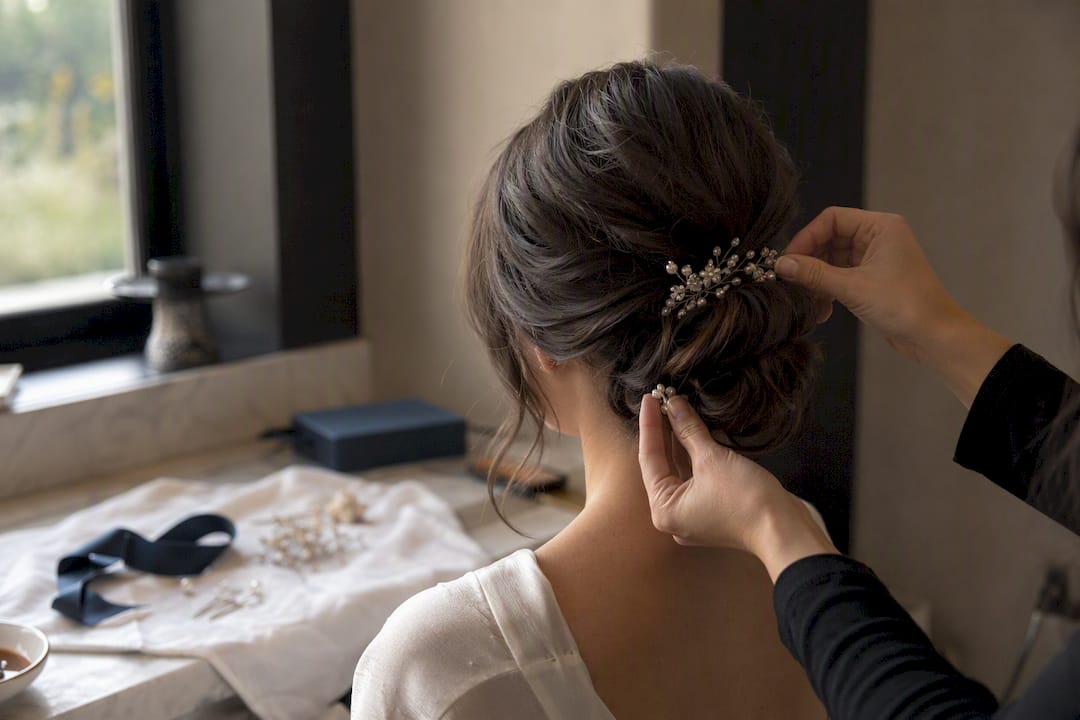
Book your bridal hair trial 6 to 8 weeks before your wedding, and bring your dress details, veil, and inspiration photos with you. Three things to do today: call your salon to lock in a date, gather three or four photos of styles you love, and photograph your dress neckline on your phone.
Book the trial 6 to 8 weeks out (earlier if you need extensions or a colour change)
Bring your veil, hairpins, and a photo of your dress neckline
Photograph the finished style from the front, back, and sides before you leave the chair
Key Takeaways
Booking a bridal hair trial 6 to 8 weeks before the wedding, arriving with photos and accessories, and photographing the finished style from every angle together prevent most wedding-morning surprises.
Point | Details |
Book 6 to 8 weeks out | Earlier if you need extensions, a colour change, or a large bridal party trial. |
Bring the full kit | Photos, veil, dress neckline photo, extensions, and hairpins, all in one visit. |
Test under real conditions | Check movement, heat, and humidity, not just how the style looks freshly finished. |
Speak up at the chair | Ask for changes or decline suggestions confidently; it’s your final call. |
Book with Arqhair | Arqhair runs a full consultation, tests the style, photographs it, and hands you written notes to carry through to the wedding day. |
Table of Contents
Why a bridal hair trial matters
A trial is a rehearsal, not a formality. It lets your stylist test a style against your actual hair, in daylight, with the accessories you’ll actually wear, rather than guessing from a Pinterest board. Industry guidance consistently frames the bridal hair trial as a rehearsal that catches problems while there’s still time to fix them.
It’s also where you find out whether you and your stylist actually work well together. Trials commonly expose issues you’d never predict: an updo that looks lovely at 10am, but sags by 3pm, a veil comb that won’t sit against a particular parting, or hair extensions that clash with your natural colour under venue lighting.
Longevity: does the style survive hugging, dancing, and a few hours of heat?
Veil placement: does the comb sit securely without pulling at the style?
Accessory fit: do combs, pins, or a headpiece actually work with this specific style?
Pro Tip: Ask your stylist to recreate your trial hairstyle without looking at photos or notes. If they can’t repeat it convincingly, book a second trial before the big day.
When to schedule your wedding hair trial
Most stylists recommend booking your trial around 6 to 8 weeks before the wedding, though the right window shifts depending on what you’re asking your hair to do. Some UK stylists suggest trials around 8 to 10 weeks out, particularly in peak wedding season, when weekday slots are often all that’s left.
Straightforward styles on your natural hair: 6 to 8 weeks before
Styles involving extensions, complex braiding, or bridal party trials: 8 to 12 weeks before
Trials paired with a colour change: allow 4 months, so colour and cut settle before styling
Before you hang up the phone, confirm these details:
Deposit amount and whether it’s deducted from your wedding-day fee
Your preferred stylist by name, not just “a stylist”
Whether weekday appointments are available if weekends are booked solid
What to bring and how to prepare for your trial
Turning up prepared is the single biggest factor in getting a useful result from one appointment rather than three. Wash your hair the way you normally would before styling. Most stylists prefer hair that’s a day old rather than freshly washed, since fresh hair can be too slippery to hold a style, though it’s worth checking your salon’s own guidance beforehand.
Avoid trying a new colour, gloss, or keratin treatment in the days immediately before your trial. Colour needs time to settle and can behave unpredictably under styling heat if it’s too fresh, so leave at least a couple of weeks between a colour appointment and your trial.
Here’s your bring list:
Three or four photos of styles you like, ideally on hair of similar length and texture to yours
Your veil and any headpieces, combs, or hairpins you plan to wear
Your dress, or at minimum a clear photo of the neckline and back detail
Any extensions you own or plan to buy, brought to the trial rather than sourced on the day
A note of any hair concerns: a stubborn cowlick, a thinning patch, or a section that never holds curl
Wear a plain white or pale top with a similar neckline to your dress. It sounds trivial, but it makes a huge difference to how the photos read afterwards. Once the style is finished, get someone to film a slow turn of your head, plus stills from the front, back, and both sides. As one bridal specialist puts it, bringing photos, accessories, and a similar neckline gives your stylist the clearest possible brief.
Pro Tip: Save your checklist as a photo on your phone the week before your trial, so you’re not scrambling to remember hairpins on the morning of the appointment.
What happens during a bridal hair trial appointment
Knowing the shape of the appointment means you can use every minute of it well. Most trials run 60 to 90 minutes, though a trial can stretch to two hours or more if you’re testing more than one style or working with extensions.
Consultation: you talk through your dress, venue, and the mood you want, photos in hand
Prep: your stylist works with your hair as it comes, sometimes starting on second-day hair
Styling: the first look goes in, then accessories are added and adjusted
Testing and photos: movement checks, a mirror walk, and photos from every angle
Notes: your stylist records the products, sections, and pins used for the wedding morning
If you have a large bridal party or you’re testing two entirely different styles, ask for extra time when you book. A UK stylist’s advice to allow up to two and a half hours for a full trial with photography is a sensible benchmark for anything beyond a simple down style.
Test movement: shake your head, hug someone, sit down and stand up
Ask about heat and humidity: will this style hold in an outdoor June ceremony?
Get the product list in writing before you leave
What a trial costs and how many you’ll need
Trial pricing varies considerably by salon and region, and it’s usually charged separately from your wedding-day styling fee rather than folded in automatically. Some salons include a trial within a bridal package; others list it as a standalone charge with the fee credited against your final booking. The Knot’s guide to trial pricing notes that costs in the US market vary widely by artist and location, and the same principle holds wherever you’re booking.
One trial is enough for most brides. A second is common if the first attempt needs real changes, such as swapping from an updo to a half up style, rather than small tweaks like pin placement.
Before you pay a deposit, ask:
Is the trial fee deducted from the wedding-day total, or is it separate?
What happens if you need to reschedule?
Does the price include products, or will you need to buy anything for the day itself?
Is there a travel charge if you want your stylist to come to you?
How to choose the right stylist and what to ask
Look past the portfolio’s prettiest photos and check for consistency. A stylist with dozens of similar, well finished bridal updos across different hair types tells you more than one flawless hero shot. Ask specifically to see back and side views, since front-on photos hide a multitude of pinning sins.
At the trial itself, ask direct questions:
How long will this style realistically hold, and in what conditions?
Will you need extensions, and do you supply them or should I bring my own?
What time will you need to start on the wedding morning for this look?
Can you talk me through touch-ups I could do myself between the ceremony and the reception?
Be wary of vague answers about longevity, reluctance to test your actual veil or comb, or a portfolio that looks inconsistent from one wedding to the next.
Pro Tip: If a stylist can’t tell you roughly what time they’d need to start on your wedding morning, that’s a sign they haven’t thought through the logistics of your specific style yet.
How Arqhair approaches the bridal hair trial
At Arqhair, every bridal trial starts with a proper consultation, not just a quick chat while you’re in the chair. We talk through your dress, your venue, and the photos you’ve brought, then style, test, and photograph the result from every angle before you leave. You walk out with a written note of the products and technique used, so your wedding-morning appointment starts from a proven plan rather than a guess.
Our team includes Wella Colour Experts with a family legacy spanning three decades, and you can browse real finished looks in our transformations gallery before you book. Trials can be arranged as part of our bridal packages or as a standalone appointment.
The best trials end with the bride seeing her own wedding day in the mirror, not just a nice hairstyle.
Full consultation before any styling begins
Photographic record from front, back, and both sides
Written product and technique notes handed over at the end
Book your bridal trial through our cutting and styling service page.
How to communicate your hair goals during the trial
The trial only works as well as the brief you give it. Vague requests like “something elegant” leave your stylist guessing, and guessing is exactly what a trial exists to avoid. Instead, describe how you want to feel: polished and controlled, soft and undone, dramatic with height at the crown. Feelings translate into technique far more usefully than adjectives like “pretty” do.
Bring photos, but be specific about what you like in each one. Point at the volume in one picture, the loose front pieces in another, and the low bun placement in a third, rather than handing over five images and hoping your stylist picks the right elements from each. If a photo shows a style you love but on very different hair to yours, say so, and ask what would need to change to translate it onto your hair type.
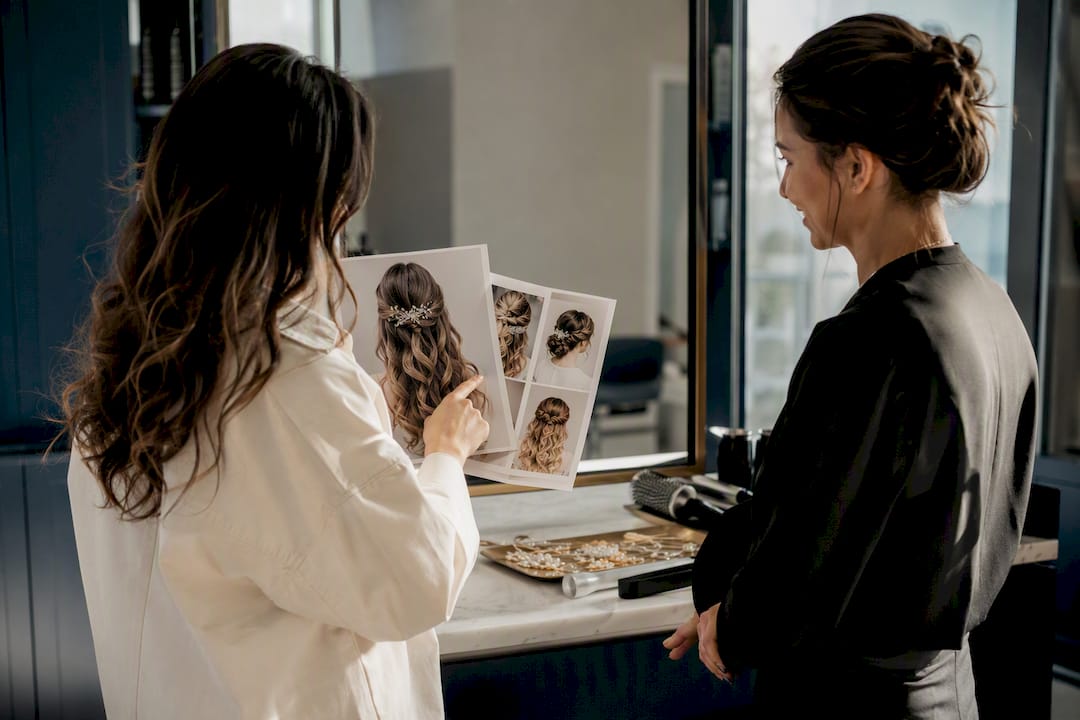
Speak up during the process, not just at the end. If a section feels too tight, too heavy, or wrong for your face shape, say it while your stylist can still adjust, rather than nodding along and hoping it settles. Good stylists want that feedback mid-appointment; it’s far easier to shift a pin than to undo a finished look and start again.
Bring your partner, a parent, or a trusted friend if their opinion matters to you, but choose one voice, not a committee. Too many opinions in the room tends to muddy the very clarity a trial is meant to deliver.
Planning your trial around weather and wedding-day conditions
Your trial should reflect the conditions you’ll actually face on the day, not a calm salon afternoon. If you’re marrying outdoors in summer, mention the heat and humidity at your trial so your stylist can test how the style holds under those conditions, not just how it looks fresh out of the chair.
Humidity is the biggest wildcard for most brides. Fine, straight hair often drops volume quickly in damp air, while curlier textures can frizz or expand beyond the shape you tested. Ask your stylist which products or techniques combat this, and request that they use those same products at the trial so you can judge the real result rather than a best-case version.
Wind matters more than most brides expect, particularly for coastal or countryside ceremonies. A loose, romantic style with soft tendrils can look wonderful in photos but unravel within minutes outdoors. If your ceremony or photos will happen outside, ask your stylist to test the style with a fan or simply by stepping outside for ten minutes during the trial.
Cold weather brings its own issue: static, especially with fine or freshly washed hair. If you’re marrying in winter, mention it, so your stylist can use anti-static products or adjust the finish accordingly.
Finally, think about the full day’s timeline. A style that holds for four hours might not survive an eight-hour day that runs from getting-ready photos through to the last dance. Tell your stylist your full schedule so they can pin and product accordingly, not just for the ceremony hour.
Handling allergies and unexpected reactions during the trial
A trial is also your safety check, and it’s far better to discover a reaction to a product weeks before the wedding than on the morning itself. If you have known allergies or sensitivities, tell your stylist before they touch your hair, not partway through the appointment. Mention specific ingredients you react to if you know them, such as certain fragrances, sulphates, or particular styling sprays.
If you’ve never had a reaction before but you’re naturally cautious, ask your stylist to patch test any new product on a small section of skin, such as behind the ear, at least 24 hours before the full trial. This applies particularly to spray adhesives used for securing wigs or hairpieces, and to strong-hold hairsprays with unfamiliar formulations.
Watch for signs during and after the trial: itching, redness, a tight or burning scalp sensation, or unexpected shedding. If anything feels off, tell your stylist immediately so they can rinse the product out and switch to an alternative. A good stylist will treat this as useful information, not an inconvenience.
If a reaction does happen, don’t panic and don’t assume it rules out your chosen style. Often it’s one specific product causing the issue, and swapping to an alternative brand or formulation solves it completely. Note down exactly what caused the reaction so it can be avoided at every future appointment, including the wedding morning itself.
Bring a list of your current hair and skin products to the trial as well, since some reactions come from product combinations rather than a single culprit. Your stylist can flag anything likely to clash before it becomes a problem on the day that matters most.
What to do after your trial, before the wedding day
Walking out of your trial happy is only half the job. Once the appointment ends, write down everything while it’s fresh: the products used, the order things were done in, and anything you’d tweak next time. Ask your stylist to email or text you this summary if they haven’t already offered one, so nothing relies on memory alone.
Confirm the final timing estimate for your wedding morning and work it backwards from your ceremony time. If your trial took two hours, assume the wedding-day version will take similarly long once nerves, extra guests, and photography are factored in, and build that into your morning schedule with room to spare.
Send your stylist a copy of your final day-of timeline once it’s confirmed, including who else needs styling and in what order. If your bridal party wasn’t at the trial, share their hair types, lengths, and any requests with your stylist ahead of time so there are no surprises when they arrive.
If anything changes between your trial and the wedding, tell your stylist as soon as you know. A change of venue from indoors to outdoors, a different veil, or even a haircut in the weeks before the wedding can all affect how the trialled style performs, and your stylist needs the chance to adjust the plan.
Finally, keep your trial photos somewhere easy to find, ideally shared with your stylist again a week before the wedding as a refresher. It sounds unnecessary when the appointment felt so recent, but weddings involve dozens of details, and a quick visual reminder saves everyone time on the morning itself.
Saying yes or no to changes with confidence
Trials exist so you can ask for changes, and a confident bride treats that as an invitation rather than an imposition. If something isn’t right, whether it’s too tight, too soft, too high, or simply not “you” when you see it in the mirror, say so plainly. Phrases like “could we try it a little looser at the crown” give your stylist something concrete to act on, and a skilled stylist will welcome the direction.
Equally, you’re allowed to decline a suggestion. If your stylist proposes an accessory or technique you don’t love, you don’t need an elaborate justification. “I’d rather not, I want to keep it simpler” is a complete sentence. This is your wedding day, and the final call sits with you, not with whoever has the strongest opinion in the room.
Watch for pressure dressed up as expertise. There’s a difference between a stylist explaining why a technique will hold better structurally, which is worth listening to, and a stylist pushing a style because they personally prefer it. If you’re unsure which one you’re hearing, ask directly: “is that for how it looks, or how it holds?”
Trust your gut over the mirror in the first thirty seconds. Bridal styles often look unfamiliar at first simply because they’re different from your everyday hair, so give it a minute, walk around, and look from a few angles before deciding it’s wrong. But if the doubt persists after that, don’t talk yourself into a style you’re not genuinely excited about. A trial with no changes at all is rare, and asking for adjustments is exactly what the appointment is for.
What matters most in the trial process
Most bridal hair advice focuses on Pinterest boards and inspiration photos, and that’s the least important part of the process. What actually determines whether your wedding-day hair works is whether your stylist tested it under real conditions and wrote everything down.
Too many trials end with a bride saying the style looked lovely, without anyone checking whether it survives movement, weather, or eight hours on a head. The conventional advice to “bring inspiration photos” undersells what a trial is for. It’s a stress test, not a mood board session.
If there’s one thing brides should prioritise above all else, it’s insisting on a second look from every angle and a written product list before leaving the chair. Photos fade from memory faster than you’d think, and the details that make a style repeatable on the day, the exact pins, the parting, the product order, are the ones most easily lost between the trial and the wedding morning.
Book your bridal trial with Arqhair
Arqhair offers something a checklist alone can’t: a stylist who tests your look properly, photographs it from every angle, and hands you a written record before you leave the chair. Rather than piecing together advice from different guides and hoping it holds together on the day, you get one consultation, one trusted stylist, and one clear plan carried through to your wedding morning.
Our team’s decades of family experience and Wella Colour Expert training mean your trial isn’t a guess dressed up as a rehearsal. It’s the real test, done properly. If you’re planning a colour change alongside your style, our colour and highlights and balayage services can be scheduled well ahead of your trial so everything settles in time. Get in touch to book your bridal hair trial and secure a date that fits your wedding timeline.
Sources
Recommended
Comments