
Hair Colour Options During Pregnancy: What Is Safe

Last Updated: November 8, 2026
Quick Summary
The safest hair colour options during pregnancy are foils, balayage and other techniques that keep product off your scalp, plus ammonia-free and PPD-free formulas. Always have a patch test 48 hours before your appointment, and ask your colourist to read the ingredient label with you.
Foils and balayage keep colour off the scalp, reducing skin contact and fumes.
Ammonia-free colour does not automatically mean the formula is PPD-free.
A patch test is applied to your skin 48 hours before your appointment.
Many colourists prefer the second trimester for first-time colour.
Henna and metallic salts can react badly with later chemical colour, so strand test first.
Pregnant and unsure about colouring your hair?
We patch test, use gentle formulas and plan foils to limit scalp contact.
Table of Contents
What Hair Colour During Pregnancy Actually Involves
Hair colour options during pregnancy come down to one question: how much product touches your scalp. Most colour decisions in pregnancy are about contact time and chemical load, not about avoiding colour altogether.
Colour reaches your scalp in three ways:
Direct dye applied to the roots and skin
Rinse water carrying residue across the scalp
Fumes from the product while it develops
A patch test and a proper consultation matter more than any label. Below, we explain what each option involves so you can decide with your colourist, not against them.
Hair Dye During Pregnancy: What the Ingredients Tell You
Hair dye during pregnancy raises concerns because some traditional formulas contain strong chemicals. The main ones are ammonia, PPD and resorcinol. Understanding what each does helps you judge a product, rather than trusting a "natural" label.
Ammonia, PPD and Resorcinol Explained
Ammonia opens the hair cuticle so colour can enter. It is the source of that sharp salon smell and can irritate eyes and airways.
PPD (para-phenylenediamine) is a dye molecule used in permanent colour. The NHS guidance on hair dye allergy and patch testing is clear that a reaction can build over repeated exposure.
Resorcinol is a colour coupler that works alongside PPD. Some people with sensitive scalps report irritation from it.
If ingredient safety is your main worry, it helps to compare gentler formulations before you book. Our 7 things to check before booking an eco-friendly colour walks through exactly what to look for on a label.
Ammonia-Free Hair Dye During Pregnancy: What It Does and Does Not Solve
Ammonia-free hair dye during pregnancy removes the smell and the fume irritation. It does not automatically remove PPD.
A common mistake is assuming "ammonia-free" means "chemical-free". It does not. Many ammonia-free permanent colours still use PPD to achieve grey coverage and lasting tone.
What it does not do:
Guarantee a PPD-free formula
Lighten hair as strongly as a high-lift colour
Ask your colourist to read the ingredient list with you. That single step tells you more than the front of the box.
Highlights During Pregnancy: Why Foils Change the Risk Profile
Highlights during pregnancy are often the option colourists feel most comfortable recommending. The reason is simple: foils keep the product off your scalp.

Balayage, Foils and Scalp Contact
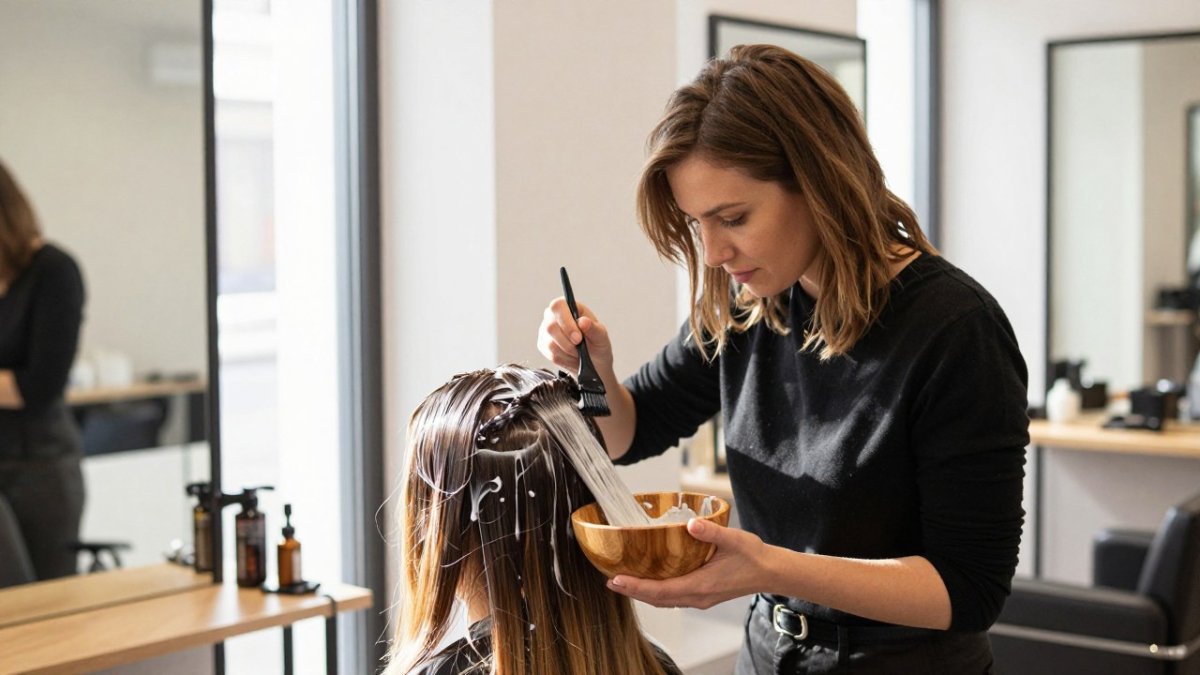
With foils and balayage, colour is painted onto sections of hair and wrapped away from the skin. Your scalp is not sitting in dye for 30 minutes.
That reduces skin contact and cuts the fumes you breathe in. It is why many expectant clients switch to highlights or balayage for the duration of pregnancy.
The trade-off is upkeep. If you want to understand how placement is planned, our guide to bespoke hair colour in London explains the process from consultation to finish.
Hair Colour Alternatives During Pregnancy for Damaged or Sensitive Hair
Hair colour alternatives during pregnancy suit anyone with a reactive scalp or weak, damaged hair. But the useful question is not simply which option is gentler, it is which option is compatible with the hair you already have. A deposit-only colour on hair that has been bleached repeatedly will behave very differently from the same product on virgin hair, and a plant dye over a previous permanent colour can produce an unexpected result.
First, assess the hair you have
Before choosing a colour, work through these questions with your colourist:
What is the history? Previous bleach, permanent colour, henna or metallic salts all affect how a new colour will take, fade or react.
What is the condition? Porosity, breakage and elasticity tell you whether the hair can tolerate any lifting at all.
What is the goal? Grey coverage, a tone refresh, lightening or a full shade change each point to a different product type.
When to colour, when to pause
Deposit-only colour and gloss sit on the surface of the hair and involve little or no lifting, which is why they are often discussed as options for hair in reasonable condition. Permanent colour with ammonia or PPD is a bigger step, and high-lift lightening on already damaged hair is the option most colourists would pause until after pregnancy or until the hair has been cut back.
A simple rule of thumb:
Healthy hair, grey coverage needed: semi-permanent or permanent colour with foils to limit scalp contact.
Damaged or over-processed hair: deposit-only colour, gloss or toner; avoid lifting.
Previously hennaed or metallic-salt-treated hair: strand test and professional assessment before any new colour.
The alternatives, and what each is actually for
Semi-permanent colour: deposits tone with no ammonia and low peroxide. Fades over several washes. Best for blending early grey or refreshing tone on hair that does not need lifting.
Temporary colour: sits on the surface and washes out. Good for a one-off event, not for coverage.
Henna and plant-based colour: botanical, but not risk-free. Patch test first, and be aware that henna and metallic salts can interact badly with later chemical colour.
Watch out: assuming a plant-based or "natural" dye is automatically compatible with previous colour. Because reactions can be unpredictable, keep the rest of your routine simple too, and consider whether Iuvo Skincare fits your approach to avoiding parabens in daily skincare.
For a sensitive scalp, sometimes the better move is care rather than colour. Our salon-tested scalp treatment benefits explains why monthly conditioning sessions help.
Here is how the main colour alternatives compare for hair condition and purpose.
Option | Best for | Key difference |
Semi-permanent colour | Blending early grey or refreshing tone | No ammonia, low peroxide, fades over several washes |
Temporary colour | A one-off event | Sits on the surface and washes out |
Henna and plant-based colour | Botanical option | Not risk-free; can interact badly with later chemical colour |
Gloss or toner | Dull or brassy hair | Adds shine and tone without lifting |
No colour at all | Sensitive scalp or fragile hair | A cut and deep conditioning treatment instead |
Patch Tests, Trimesters and Questions to Ask Your Colourist
A patch test is a small amount of colour applied to your skin 48 hours before your appointment to check for reaction. It is the single most important safety step, and any reputable salon will insist on it. But a patch test is only useful if you know what you are looking for and what it does not cover.
What a patch test actually tells you
A patch test checks for an allergic reaction to the specific formula being used. A common pattern is for a reaction to build over repeated exposure, which is why the NHS guidance on hair dye allergy and patch testing is clear that a previous safe colour does not mean the next one will be.
What to watch for in the 48 hours after a patch test:
Redness, itching or swelling at the test site
A rash spreading beyond the test area
Any breathing difficulty or swelling of the face or throat, seek urgent medical advice
If you react, do not proceed with the colour. Ask your colourist to review the formula and consider a PPD-free alternative.
Reading the ingredient label
The front of the box is marketing; the back is the formula. Look for:
PPD (para-phenylenediamine) and related dye molecules such as PTD, the most common cause of allergic reaction.
Ammonia, the source of fumes and scalp irritation, but not the same as PPD.
Resorcinol, a colour coupler that some sensitive scalps react to.
A product can be ammonia-free and still contain PPD. Ask your colourist to read the label with you rather than relying on the front-of-pack claims.
Timing and trimesters
Many colourists prefer the second trimester for first-time colour, when early nausea has usually settled and the appointment is more comfortable. Others will colour at any stage with foils and good ventilation. There is no single rule that fits everyone, so the practical approach is to discuss timing with your colourist and your midwife, and to prioritise foils, ventilation and patch testing at every stage.
Questions worth asking before you book
Which of your colours are PPD-free as well as ammonia-free?
Will foils keep the product off my scalp?
Can we do a patch test 48 hours ahead?
A proper consultation should leave you with a written plan, timeline and cost. Our haircut consultation with Wella expertise shows what that conversation should cover.
Watch out: skipping a patch test to save time is the one shortcut that can turn a routine appointment into a reaction you have to manage for weeks.
Finding Pregnancy-Safe Hair Colour in London
London salons vary widely in how they handle pregnancy colour. Some stock full low-tox ranges. Others simply reach for an ammonia-free box and call it safe.
Use this checklist when you call around:
Ask whether they patch test as standard
Confirm they offer PPD-free and ammonia-free options
Ask if foils or balayage are used to limit scalp contact
Check the salon is well ventilated
If you are searching for pregnancy-safe hair colour nearby, prioritise a salon that answers these questions without hesitation. Vague answers are a warning sign.
Watch out: booking a colour without a patch test to save time is the one shortcut that can turn a routine appointment into a reaction you have to manage for weeks.
Book a Pregnancy-Safe Colour Consultation at ARQ Hair
Pregnancy does not have to mean months of roots and dull tone.
ARQ Hair offers gentle colour options for clients with ammonia sensitivity.
You can see what a consultation leads to on our hair packages in Fulham page, covering colour, balayage and blow-dry bundles.
Get started with ARQ Hair and book a consultation that puts your safety and your colour result on the same page.
Frequently Asked Questions
Can you dye your hair during pregnancy?
Most people can colour their hair during pregnancy, but timing and technique matter. Many colourists and midwives suggest waiting until after the first trimester, when the baby's development is most rapid, before booking a full-head colour. Choosing a salon that applies colour with foils and offers ammonia-free formulas can reduce exposure further. Ask about a patch test at least 48 hours before your appointment, even if you have been coloured many times before, because sensitivity can change during pregnancy.
Are highlights or balayage a better option during pregnancy?
Highlights during pregnancy are often preferred because foils keep the colour off your scalp. That means less product sits directly on skin, and the ammonia vapour you breathe in is reduced compared with a full-head tint applied at the roots. Balayage works the same way. If you need grey coverage at the root, ask your colourist whether a gentler formula or a partial foil placement can achieve a similar result without a full scalp application.
Is ammonia-free hair dye during pregnancy genuinely safer?
Ammonia-free hair dye during pregnancy removes one irritant from the process, but it is not automatically risk-free. Ammonia-free formulas can still contain PPD, which is among the ingredients most commonly linked to allergic reactions. Read the ingredient list rather than relying on the front-of-box claim. If you have reacted to colour before, ask whether a low-PPD or PPD-free option is available and request a patch test.
What should I ask my hairdresser before having my hair coloured while pregnant?
Ask four things: which formula they plan to use and whether it contains ammonia, PPD or resorcinol; whether they can keep colour off your scalp using foils; whether the salon is well ventilated; and whether they will do a patch test at least 48 hours beforehand. Also mention how far along you are, any change in scalp sensitivity you have noticed, and whether you are happy to reschedule if the appointment falls in the first trimester. A good colourist will talk through hair colour alternatives during pregnancy rather than pushing one option.

Comments