
Hair colour levels: how to read the professional 1–10 scale

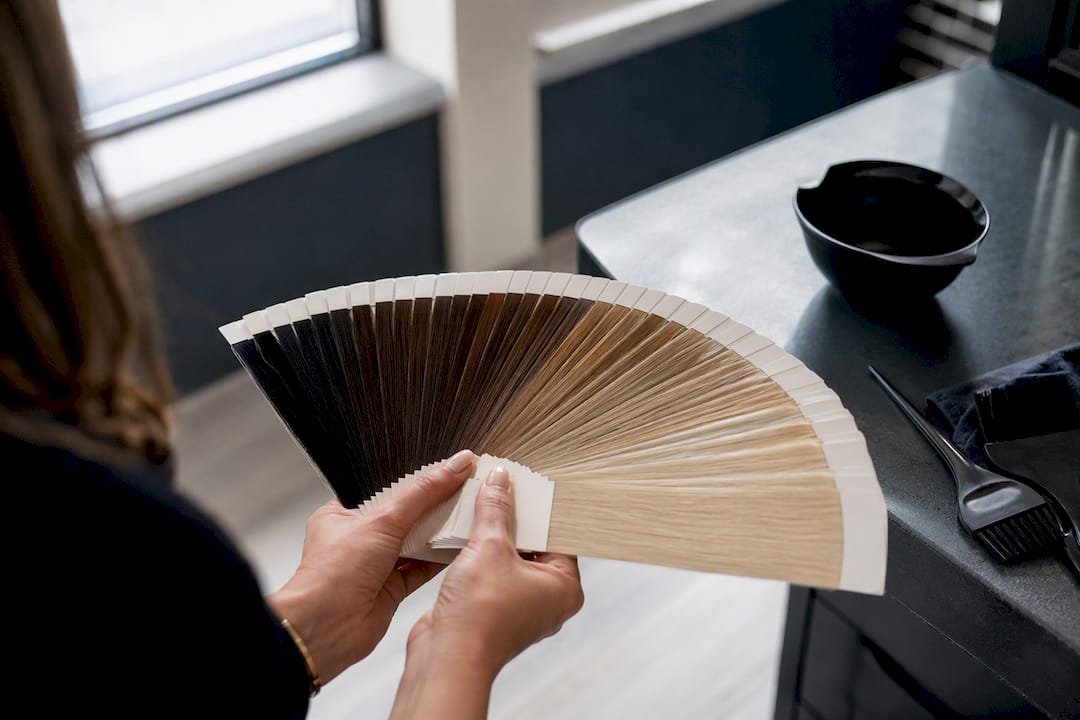
The hair colour level system runs from 1 (black) to 10 (the lightest blonde); every professional colour code you’ll ever see starts with this number. It tells you and your colourist exactly how dark or light a shade is, before a single decimal or letter adds tone into the mix.
The one rule worth remembering before your next appointment: dye alone typically lifts hair 1 to 2 levels safely, while bleaching can move you 3 to 4 levels in a single session, condition depending. Bigger jumps usually mean staged visits, not one dramatic sitting, especially to protect hair health.
Level 1 to 3 covers black through dark brown
Level 4 to 6 covers medium to light brown
Level 7 to 10 covers dark blonde through to the lightest blonde
Numbers after the decimal point describe tone, not depth
Key Takeaways
Hair colour level measures depth from 1 (black) to 10 (lightest blonde), and safe lift limits, decimal tone codes, and your hair’s porosity and history together determine what result you’ll actually get.
Point | Details |
Level equals depth, not tone | The number before the decimal shows how light or dark hair is; tone comes after the point. |
Respect lift limits | Expect 1 to 2 levels with dye and 3 to 4 with bleach per session, condition depending. |
Check level in daylight | Judge your current level in natural light against roots, not sun-lightened mid-lengths or ends. |
Match product to level gap | Semi-permanent suits same-level tone changes; bleach is needed for larger upward jumps. |
Bigger jumps need staging | Treat multi-level lifts as a multi-session process, with conditioning between appointments. |
Table of Contents
Understanding hair colour levels from 1 to 10
Every level corresponds to how much melanin sits in the hair, and melanin is the whole story here. More pigment means darker hair and a lower number; less pigment means lighter hair and a higher one. This is why the hair colour numbering system is treated as a universal standard across salons and brands, even when the swatch names differ.
Here’s what each whole number generally represents:
Level 1 – Black, the deepest possible depth with almost no visible warmth
Level 2 – Darkest brown, close to black but with a hint more openness
Level 3 – Dark brown, still rich but starting to show a lift
Level 4 – Medium brown, the most common natural base among European hair types
Level 5 – Light brown, where warmth starts to become visible under light
Level 6 – Dark blonde, sitting right on the brown to blonde border
Level 7 – Medium blonde, a level many colourists treat as a natural pivot point
Level 8 – Light blonde, noticeably brighter with more underlying warmth exposed
Level 9 – Very light blonde, close to platinum but not quite there
Level 10 – Lightest blonde, pale and cool with minimal remaining pigment
Some professional charts push further, to 11 or even 12 for ultra-lift blondes. Treat these as specialist territory. They’re formulated differently to standard levels and normally require a colourist’s judgement rather than a home box.
How to read a professional hair colour code
A code like 6.13 isn’t as cryptic as it looks once you know the pattern. The number before the decimal point is always the level, meaning how light or dark the result will be. Everything after the decimal describes tone, the actual colour reflect you’ll see once the level is achieved.
The first digit after the point usually signals the dominant tone, and the second refines it. In 6.13, that’s level 6 (dark blonde) with an ash primary tone and a golden secondary reflect underneath.
Manufacturers broadly follow these decimal conventions:
.1 – Ash or cool tone
.3 – Gold
.4 – Copper
.5 – Mahogany or red-violet
.44 or repeated digits – An intensified version of that same tone, used when the standard shade isn’t strong enough to counteract heavy warmth
So 7.44 means level 7 with a strongly intensified copper reflect, the kind of formula used when someone’s natural warmth needs serious counteracting rather than a gentle nudge.
Pro Tip: If you’re comparing boxed dye across brands, check the decimal pattern first, not just the shade name. “Caramel Blonde” from one brand might sit two full levels away from another brand’s version with the same name.
Determining your current hair level before a colour change
Getting your starting point right matters more than most people assume, because every lift calculation your colourist makes depends on it. Here’s how to check it properly before you book:
Look in natural daylight, not under bathroom bulbs or salon spotlights, which both distort depth and warmth
Compare against a greyscale or level chart held right next to a few strands, ideally mid-length, not just at the ends
Take close-up photos in that same natural light, since phone cameras often catch tonal detail your eye misses in the moment
Check your roots and undercoat separately from the rest of your hair, as sun exposure and previous colour can lighten the mid-lengths while roots stay at your true natural level
Bring swatches or reference photos to your consultation rather than describing a shade in words, which leaves far too much open to interpretation
Undertone plays tricks on people constantly. Warm ambient lighting can make a level 5 look like a level 6, which is exactly why professional consultations happen under neutral light.
What your level allows: realistic lifting and depositing
Depositing colour, meaning adding pigment without lightening, works at almost any level with minimal risk. Lifting, meaning removing pigment to go lighter, is where the real limits kick in.
Oxidative permanent dye can usually lift 1 to 2 levels while depositing new tone in the same process. Bleach works differently: it strips pigment without depositing anything, which is why it manages 3 to 4 levels of lift in one session, sometimes more on virgin hair in excellent condition.
Going from level 3 to level 9 in one visit isn’t a level 1 dye job, it’s a multi-session lightening project
Hair condition directly affects developer strength and processing time, since compromised hair lifts faster but also breaks down faster
Previous colour history, porosity and undercoat distribution all factor into how many levels a colourist will attempt safely in one sitting
A jump of six levels or more almost always gets split across appointments. Anyone promising it in one visit is usually gambling with your hair’s structure, not just its colour.
Neutralising unwanted tones: the colour wheel in practice
Underlying pigment shifts predictably as you move up the level scale, and this is the mechanic behind every toning decision a colourist makes. Darker levels reveal deep red and red-orange underneath. Mid-range levels expose orange. Lighter levels reveal yellow, fading to pale yellow at the very top of the scale.
Toners work by cancelling out that exposed pigment using complementary colours sitting opposite each other on the colour wheel:
Violet neutralises yellow, the standard fix for brassy blondes at level 8 and above
Blue neutralises orange, commonly used on level 5 to 7 hair that’s lifted and gone warm
Green neutralises red, useful on darker levels where red pigment dominates
Brassiness at level 9 usually calls for a violet-based toner. The same brassiness sitting at level 6 needs a blue-based one instead, because the underlying pigment simply isn’t the same colour.
Pro Tip: If your blonde keeps turning brassy within weeks, ask your colourist whether your toner’s violet base is strong enough for your water and sun exposure, not just your starting level.
Common colour codes and what they actually mean
Reading a swatch chart gets easier once you’ve decoded a handful of real examples. Here’s what shows up most often:
Level 5 – Plain light brown, no decimal, meaning a natural depth with minimal added tone
Level 6.1 – Dark blonde with an ash primary tone, popular for cooling down natural warmth
Level 7.44 – Medium blonde with intensified copper, used to correct or create strong warmth
Level 8.3 – Light blonde with gold, a classic warm blonde result
Level 10.21 – Lightest blonde with violet primary and ash secondary, common in high-lift cool blondes
Swatch charts vary slightly by brand even at the same numbered level, since pigment concentration and base formulas differ. A 7.44 from one manufacturer won’t sit identically to another’s, which is exactly why consultations matter more than box labels.
How ARQ Hair reads levels and tones in consultation
Ricardo doesn’t start a consultation with a swatch chart. He starts by checking your base level, your undercoat, your hair’s health and its full colour history, because a formula that ignores any of those four things is a guess dressed up as a plan.
That’s also why ARQ Hair builds bespoke formulas using Wella’s professional colour system rather than reaching for a fixed boxed number. A level 7 on one client’s hair, given different porosity and undercoat, needs a genuinely different mix to a level 7 on someone else’s.
A colour number on a chart is a starting point, not a formula. The actual mix depends on what’s already happening underneath, and that only shows up properly in person, under the right light.
Aftercare follow-ups matter just as much as the initial appointment, particularly for anyone who’s lifted several levels. Expect your colourist to check tone fade and condition at your next visit, adjusting the formula as your hair’s undercoat and porosity shift over time.
Why natural, virgin and treated hair colour differently
Virgin hair, meaning hair that’s never been chemically coloured, lifts the most predictably. Its cuticle is intact and its underlying pigment is consistent from root to tip, so a colourist can calculate lift with real confidence.
Natural hair that’s simply grown out without treatment behaves almost as predictably, though sun exposure can lighten ends slightly ahead of the roots. This is one reason colourists check both zones separately rather than judging depth from a single glance.
Chemically treated hair is a different proposition entirely. Previous colour, bleach or relaxing treatments change how the hair absorbs and releases pigment, sometimes unevenly along the same strand. Hair that’s been coloured multiple times can carry buildup that makes it read darker than its true underlying level, or patchier, with some sections lifting faster than others during a new service.
This is exactly why colourists ask about your last three colour services, not just your current shade. A level 6 that’s never seen chemicals responds nothing like a level 6 that’s been bleached twice and box-dyed once since. The formula, the developer strength and the processing time all shift based on that history, even when the starting number on the chart looks identical. Skipping this step is how colour corrections happen, and why restoring an uneven or over-processed result usually takes more sessions than getting it right the first time would have.
How porosity and texture change what a level actually looks like
Porosity, meaning how easily hair absorbs and holds moisture and pigment, has a huge effect on how a given level behaves during colouring. High porosity hair, often the result of previous chemical treatment or sun damage, absorbs colour fast and can lift quicker than expected. It can also fade faster, since the same open cuticle that let pigment in lets it wash back out.
Low porosity hair resists both lifting and depositing. It takes longer to process and can end up patchy if a colourist applies a standard timing without adjusting for it. This is part of why two people at the same starting level can walk out of two different appointments with noticeably different results, even using near-identical formulas.
Texture adds another layer. Coarser hair typically has a larger diameter and can appear slightly darker or more resistant to lift than finer hair sitting at the exact same level, purely because there’s more strand to penetrate. Curlier textures can also reflect light differently along the curl pattern, making a level look subtly different depending on the angle you view it from.
None of this shows up on a swatch chart, which is precisely why a consultation matters more than the numbered chip itself. A chart tells you what a level looks like on straight, medium-porosity hair under studio lighting. Your actual hair rarely matches that exactly, and a colourist adjusting for porosity and texture is doing real technical work, not just picking a pretty shade.
Mistakes people make when judging their own hair level
The most common error is checking level under artificial light, particularly warm bulbs that add false gold and make a level 6 read as a level 7. Natural daylight, ideally overcast rather than direct sun, gives the truest read.
A close second is judging level from mid-lengths and ends rather than roots. Sun exposure, previous colour and general wear lighten the ends of most people’s hair over time, so the roots almost always show the true natural or current level more accurately.
People also frequently confuse tone with level, describing hair as “warmer” or “cooler” when they actually mean lighter or darker. These are separate variables. A level 6 can be warm or cool depending entirely on its decimal, so mixing the two up leads to miscommunication in a consultation that a colourist then has to untangle before any actual work starts.
Relying on box dye names is another trap. “Honey Blonde” on one shelf and “Honey Blonde” on another can sit a full level or more apart, because names aren’t standardised the way numbers are. And plenty of people skip checking their undercoat entirely, meaning they get surprised by orange or red pigment emerging mid-service that a quick pre-check would have flagged.
The fix for nearly all of these is the same: check in natural light, check the roots, use numbers rather than names, and bring photos to your consultation instead of relying on memory or verbal description alone.
Choosing between permanent, semi-permanent and bleach by level
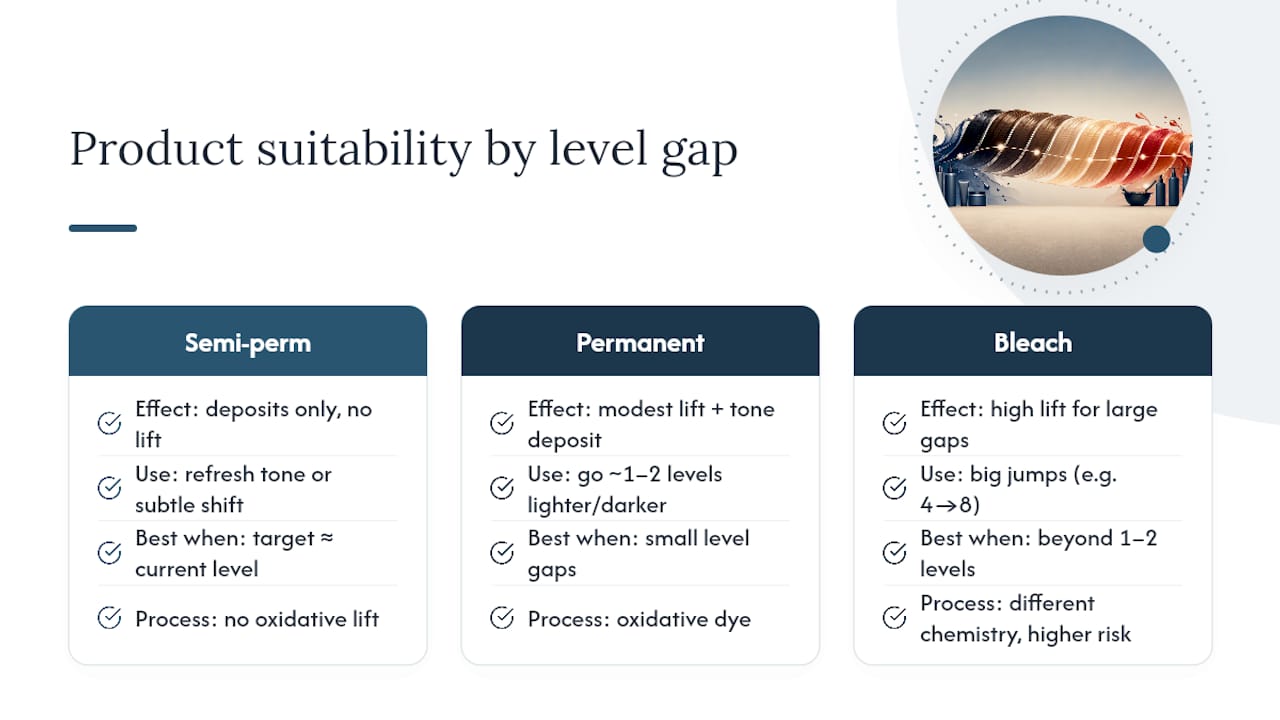
Your starting level and target level together decide which product category actually makes sense, and this is where a lot of home colour disappointments begin.
Semi-permanent colour deposits without lifting, meaning it works well when your target level matches or sits close to your current one. It’s a reasonable choice for refreshing tone or adding subtle warmth or coolness within roughly the same level, but it won’t move you upward at all.
Permanent oxidative dye can lift modestly, typically that 1 to 2 level range mentioned earlier, while depositing new tone simultaneously. This suits most people wanting to go a shade or two lighter or darker without a dramatic transformation.
Bleach becomes necessary once the gap between current and target level exceeds what oxidative dye can achieve. It’s the only product category that reliably manages a jump from, say, level 4 to level 8, though it’s a genuinely different chemical process with different risks attached, not simply a stronger version of permanent dye.
Choosing the wrong category for the level gap you’re trying to close is how people end up with patchy, uneven, or disappointingly unchanged results. A level 5 wanting level 9 reaching for a box of permanent dye will finish the process closer to level 6 or 7, not their target, because the product simply wasn’t built for that much lift.
Level gaps and the real damage risk behind them
Damage risk climbs in direct proportion to how many levels you’re asking hair to lift, not simply whether bleach is involved. A 1 level lift with dye carries minimal structural risk for most healthy hair. A 4 level lift with bleach in a single session asks considerably more of the cuticle and cortex, even on strong, virgin hair.
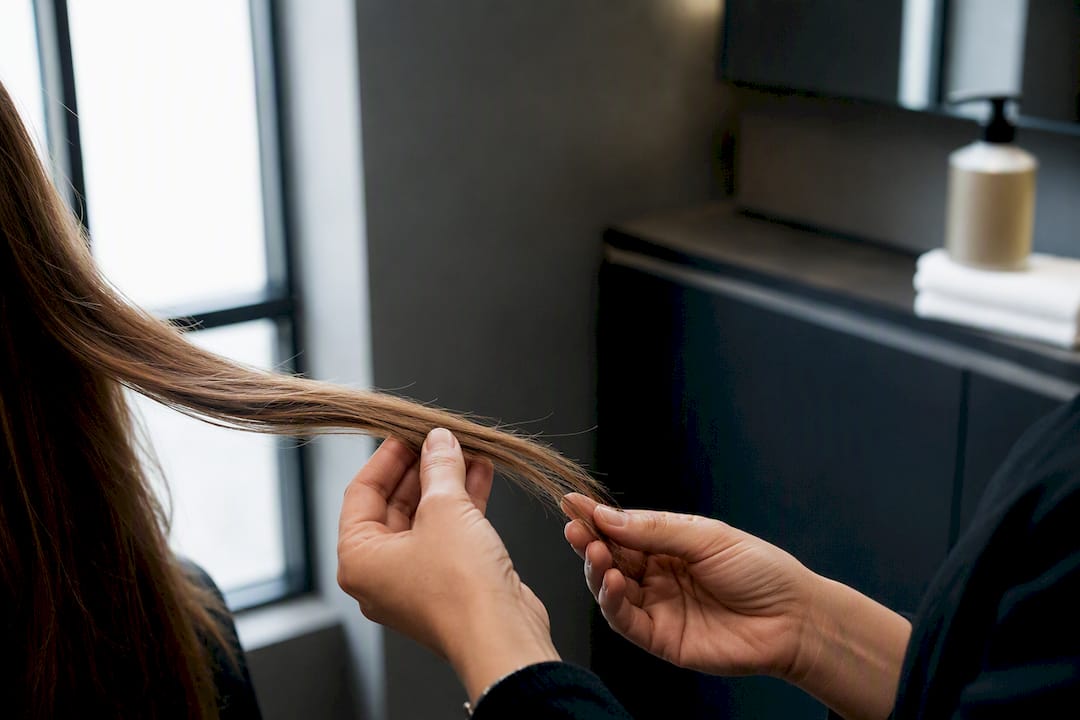
The real danger zone is combining a large level gap with hair that’s already compromised, whether from previous chemical treatment, heat styling, or high porosity from sun damage. Bleaching already-treated hair by several levels in one sitting is where breakage and severe dryness most commonly happen, because the hair’s structural reserves are already reduced before the second chemical process even starts.
This is precisely why colourists stage big transformations across multiple appointments rather than attempting them in one sitting, even when a client would prefer speed. Spacing sessions gives hair time to recover strength between lifts and lets a colourist reassess porosity and condition before pushing further.
Deep conditioning and bond-building treatments between sessions aren’t a luxury add-on for a major level change, they’re part of what keeps the process safe. Anyone planning a jump of three levels or more should expect their colourist to discuss a treatment plan alongside the colour plan, not just hand over a formula and a timer.
Where to read more on hair colour levels
For deeper detail on chart decoding, see L’Oréal Professionnel’s numbering guide and Revlon Professional’s breakdown of tone conventions, both useful references before your next consultation. If you’re colouring extensions, HairLocks’ guide to dyeing extensions safely is worth reading alongside your natural level plan.
Ready for a level change you can trust?
Reading a chart gets you halfway there. The other half is a colourist who checks your undercoat, your history, and your hair’s actual condition before mixing a single formula, rather than matching you to the nearest numbered chip. That’s the difference between a colour that looks right in the mirror at the salon and one that still looks right six weeks later.
If you’re planning a level change, from a subtle deposit-only refresh to a staged lift across several levels, book a consultation for bespoke Wella colour with Ricardo and the team. Curious what real level changes look like first? The gallery of transformations shows the kind of staged lifts and balayage work discussed throughout this guide.
Why the chart is only ever half the answer
The industry treats the 1–10 scale as gospel, and technically it is. But the obsession with getting the “right number” misses what actually determines your result: porosity, history, and undercoat, none of which show up on a swatch chip. I’d argue the chart matters less than people think, and the consultation matters more than most clients budget time for.
Where conventional advice falls short is in treating box-dye names and salon codes as interchangeable. They’re not, and that gap causes most of the disappointing results people blame on “bad colour” when it’s actually a mismatched product category for the level gap involved.
If you take one thing from this, prioritise an honest read of your current level under natural light and an honest account of your colour history before you even look at a target shade. Everything else, the decimals, the toning, the staging, follows from getting that starting point right. Skip it, and no formula, however well chosen, will land where you expect.
— RICARDO
Sources
Recommended
Comments