
How to Choose a Brunette Money Piece for Shoulder-Length Hair

Last Updated: 4 November 2026
Quick Summary
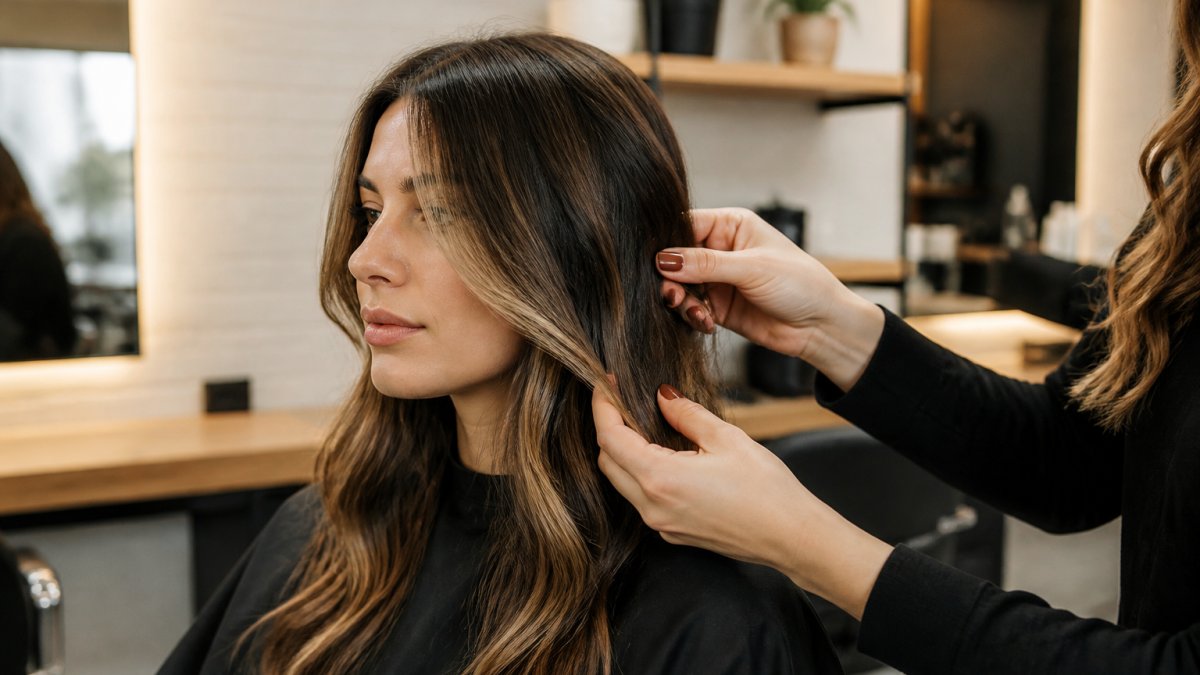
A money piece on brunette hair is a lighter section of hair framing the face, usually from the cheekbones down to the chin or jawline. On shoulder-length cuts it sits where it does the most work, so the lighter strands stay visible whether you wear your hair down, tucked or pulled back.
Medium contrast, two to three levels lighter than your base, usually works best on shoulder-length hair.
Ask your stylist to start the lightener a centimetre or two below the root and blend upward.
Describe the result in plain terms rather than asking for a shade by name alone.
Mention any box dye or henna history before lightener is mixed, as it can react unpredictably.
Book a toning or gloss appointment at the intervals your stylist recommends to keep pieces from turning brassy.
Table of Contents
Choosing a Shade for Your Undertone, Base and Contrast Level
Brunette Hair with a Blonde Money Piece: Placement Step by Step
Beige Blonde Money Pieces on Brunette Hair: Caramel, Bronde and Balayage Tones
Face-Framing Highlights for Brunettes: How They Differ From a Money Piece
Maintaining Your Money Piece: Toning, Regrowth and Colour-Safe Aftercare
Brunette hair with a money piece is one of the easiest ways to brighten your face without committing to an all-over blonde. For a fuller guide to subtle highlight placement for brunettes, see our article on subtle money piece highlights.
A money piece is the lightened section of hair that frames the face, usually starting at the cheekbones and running down to the chin or jawline.
It draws the eye upward toward the face
It adds brightness without changing your base colour
It grows out more gently than full foils
Many brunettes choose a money piece because it looks fresh but still feels like their own hair. Done well, nobody can point to it directly.
Watch out: the most common mistake is taking the lightened pieces too close to the root.
Choosing a Shade for Your Undertone, Base and Contrast Level
Most money-piece advice stops at 'warm skin suits caramel', which is not enough to walk into a salon with. The shade is really three decisions: depth of lift, tone family, and contrast against your natural base. Get those right and the money piece looks like it grew there; get them wrong and it looks like a stripe.
Start with your natural base depth
Your natural brunette depth sets the ceiling on how light you can go in one appointment without compromising condition. Most colourists work to a simple scale:
Level 2-3 (very dark brown to black): expect a two-stage process. The front pieces are pre-lightened, then toned. A single-process lift to blonde is rarely realistic in one visit.
Level 4-5 (dark brown to medium brown): a single lightening step can usually reach a warm blonde, then be toned to beige or ash.
Level 6-7 (light brown to dark blonde): the easiest base for a money piece. You can often achieve a soft beige or champagne in one appointment with minimal stress on the hair.
A very deep brunette can carry a bolder lift because the contrast reads as intentional. A soft chestnut base often looks better with a gentler, one-to-two-level lift, since a hard blonde line against warm mid-brown can look disconnected.
Match the tone family to your undertone
Tone is where most money pieces succeed or fail. The rule of thumb most practitioners use is to stay within one family of your skin's undertone, then decide how much warmth you want to keep.
Warm undertones: caramel, honey, golden beige and warm bronde. These keep the face looking lit from within.
Cool undertones: ash blonde, soft platinum, neutral beige and mushroom bronde. These read as expensive and modern against dark brown.
Neutral undertones: champagne, soft beige and 'lived-in' bronde. These are the most forgiving if you are unsure.
If you are between undertones, ask for a neutral beige and let the toner do the work.
Decide your contrast level deliberately
Contrast is the difference between the money piece and your base. It is the single biggest driver of how 'statement' the result looks.
Low contrast (one to two levels lighter): subtle, sun-kissed, very low maintenance. Best for fine hair, very dark bases where you want softness, or anyone nervous about commitment.
Medium contrast (two to three levels lighter): the sweet spot for shoulder-length hair. It reads clearly in photos and in person without looking heavy.
High contrast (three or more levels lighter): bold and deliberate. Works best when the money piece is kept narrow and the blend at the edges is feathered, otherwise it can look like two separate haircuts.
On shoulder-length hair, medium contrast usually wins because the front pieces fall past the jaw and catch light across a longer vertical section. High contrast on a short, blunt cut can look severe; on a shoulder-length layered cut it can look editorial.
Bring the right references
Photos are useful, but the wrong photos waste consultation time. Bring two or three images showing the shade you want in daylight, not filtered studio light, plus at least one image of what you do not want, so your colourist can match the tone to your skin and base rather than copying a picture taken under ring lighting.
Watch out: asking for a shade by name alone ('beige blonde', 'caramel') is the most common source of disappointment, because the same name can mean a warm level 7 or a cool level 9 depending on the colourist's interpretation. Describe the result you want in plain terms, how light, how warm, how visible, and let the toner be chosen at the bowl.
Brunette Hair with a Blonde Money Piece: Placement Step by Step
Placement is where a money piece is won or lost. The difference between a soft, face-framing lift and a hard stripe is usually a few centimetres of sectioning and a few minutes of blending. Here is what a well-run appointment actually involves on shoulder-length brunette hair.

The consultation: what your colourist needs to know
Before any lightener is mixed, your stylist should assess three things: your colour history, your hair's condition, and the geometry of your cut.
Expect to be asked:
What colour has been on your hair in the last 12-24 months, including box dye, henna and previous lightening.
How your hair behaved after the last colour service, did it feel dry, break, or go brassy quickly?
How much time you can realistically spend on maintenance.
Whether you wear your hair up, tucked or down most days, because that changes where the money piece needs to sit.
A good colourist will also look at your parting, hairline, cowlicks and any layers or fringe.
Watch out: if a stylist starts mixing lightener without asking about box dye or henna, it is worth pausing to ask.
Sectioning the front pieces
The money piece is not the whole hairline. It is a defined section on each side of the face, usually taken from the parting forward.
A typical sectioning pattern on shoulder-length hair:
The hair is parted as you normally wear it, because the money piece should sit where your parting falls.
A diagonal section is taken from the parting down to the hairline, roughly 2-4 cm wide on each side. Wider sections read as face-framing highlights; narrower sections read as a true money piece.
The rest of the hair is clipped out of the way so no lightener touches the back or crown.
The front section is then subdivided into thin slices, usually 0.5-1 cm, so the lightener penetrates evenly.
Foils versus freehand painting
There are two main application methods, and they produce different results:
Foils: the front slices are placed on foil and lightener is applied with a brush. Foils give a cleaner, more defined lift and suit high-contrast or very dark bases, because the enclosed environment speeds up the lift.
Freehand painting (balayage): lightener is painted directly onto the surface of the hair. This gives a softer, more diffused blend and grows out more gracefully, but it is less precise on very dark hair.
On shoulder-length hair this is often the best of both worlds, because the ends have enough length to show a gradient.
Lightener, developer and timing
Watch out: the most common placement error is taking the lightener too close to the root on the first slice. A line that sits too high against dark brown hair looks harsh, so ask for the lightener to start a centimetre or two below the root and blend upward.
Blending the edges
After the lightener is rinsed, the toner is applied. This is where the shade chosen at consultation becomes real, and it is also where the blend is refined.
A well-blended money piece has no visible hard line at the edge of the lightened section. The colourist achieves this by:
Feathering the lightener at the edges of each foil rather than applying a solid block.
Toning the whole front section, not just the lightened pieces, so the transition is gradual.
Checking the result in daylight before you leave the chair.
What to expect on the day
If your base is very dark or has previous colour to work through, book the longer slot, rushing the lift is the fastest way to a brassy, uneven result.
Beige Blonde Money Pieces on Brunette Hair: Caramel, Bronde and Balayage Tones
Beige blonde is one of the most popular choices for brunettes. It sits between brown and blonde, so it looks soft against dark hair.
Caramel: warm and rich, good for golden skin
Bronde: a mix of brown and blonde, very low maintenance
Balayage: painted, hand-blended pieces that look sun-kissed
Balayage is a painted, freehand technique that can create a softer gradient than foils.
If you want a bolder look, a cooler beige or light ash can add contrast. Keep it to a few pieces, though, or the face can look washed out.
Face-Framing Highlights for Brunettes: How They Differ From a Money Piece
Face-framing highlights and a money piece are close cousins, but they are not the same.
A money piece is usually a more defined, intentional section of lighter hair at the front. Face-framing highlights tend to be softer, spread across more of the hairline and blended throughout.
Feature | Money piece | Face-framing highlights |
Placement | Concentrated at the front | Spread around the face |
Contrast | Often more defined | Usually softer |
Look | Bold, deliberate | Subtle, blended |
Maintenance | Moderate | Often lower |
Choose a money piece if you want a clear statement. Choose face-framing highlights if you want a lift that looks almost natural.
Maintaining Your Money Piece: Toning, Regrowth and Colour-Safe Aftercare
Brunette money pieces are often low maintenance, but they still need care. Lighter pieces can turn brassy as they fade, and regrowth shows more against dark roots.
Book a toning or gloss appointment at intervals your stylist recommends
Use a colour-safe shampoo and conditioner
Use a purple or blue toning product if your blonde starts to look yellow
Ask your stylist for a maintenance plan that suits your lifestyle, a simple routine beats an intensive one you cannot keep up with.
Booking Your Money Piece Consultation in Fulham
If you are considering a brunette money piece, the best next step is a consultation. Read more about the salon and what a Fulham consultation involves.
Our team works with premium brands including Wella and ghd, and gentle colour options are available for clients with ammonia sensitivity.
Ready to get started? Book your consultation with ARQ Hair and find out which money piece suits your hair best.
Frequently Asked Questions
What is a money piece in hair colouring?
A money piece is a block of lighter colour placed around the face, usually at the front of the hairline and down to the cheekbones. It draws the eye to the face and brightens the overall look without colouring the whole head. On brunette hair it is often a soft caramel, beige or blonde tone. Because the lightened section is small, it grows out gradually and needs less frequent appointments than full highlights. A consultation lets your stylist match the tone to your skin and natural base before any colour is applied.
Does a money piece suit shoulder-length brunette hair?
Yes. Shoulder-length hair is well suited to a money piece because the lighter pieces sit close to the face and are easy to see when the hair is worn down or tucked behind the ears. The length also allows the colour to blend into the mid-lengths, which softens the transition. Very short or very thin hair may show the contrast more strongly, so ask your stylist to adjust the width of the pieces to suit your cut and density.
Can you get a money piece without bleaching all your hair?
Yes. A money piece only lightens the sections around the face, so the rest of your hair can stay its natural brunette or be left untouched. Your stylist may still need to lift the pieces with bleach or a lightener, which is why a patch test and a conversation about your hair's history matter, particularly if you have previously had chemical treatments. For sensitive scalps, ask about ammonia-free colour options before the appointment.
What is the difference between a money piece and face-framing highlights?
Both lighten the hair around the face, but a money piece is usually a bolder, more defined block of colour with clearer contrast, while face-framing highlights are typically finer, more blended and spread across a wider area of the front hair. Face-framing highlights suit subtle, everyday change. A money piece suits a sharper look. Your stylist can advise which approach works with your base colour and the amount of change you want.


Comments