
1 inch or 2–4 inches? Salon pros on root smudge vs root melt


A root smudge blurs a short length of regrowth with a shade close to your natural colour, keeping brightness intact through the lengths. A root melt drags that blend several inches down the shaft, building a gradient that grows out with far less contrast. Choose a smudge if you want maximum shine and lift near the crown; choose a melt if your priority is stretching salon visits and softening a bigger gap between root and ends. Either way, the right call depends on a proper consultation, not a search term.
TL;DR:
A root smudge is best for fine or lighter hair, providing a quick, bright fix within approximately one inch of growth that needs renewal every 6 to 12 weeks.
A root melt extends 2 to 4 inches down the shaft, creating a softer, dimensional gradient suitable for heavily lightened or thicker hair, lasting up to 16 weeks or more.
Proper sequencing—consultation, toning, feathering, and glossing—is crucial for both techniques to avoid banding or visible steps in the blend.
Smudges are typically quicker and cheaper per session but require more frequent visits, while melts last longer and are more forgiving for infrequent salon appointments.
Choosing between the two depends on hair history, desired maintenance schedule, and the preferred look, with stylist skill being key to achieving a seamless transition.
Table of Contents
Root smudge vs root melt: how the two techniques compare
Both techniques exist to soften the line where colour-treated hair meets natural regrowth, but they solve slightly different problems. A smudge is a quick, targeted fix; a melt is a broader piece of colour architecture that reshapes how the whole head reads.
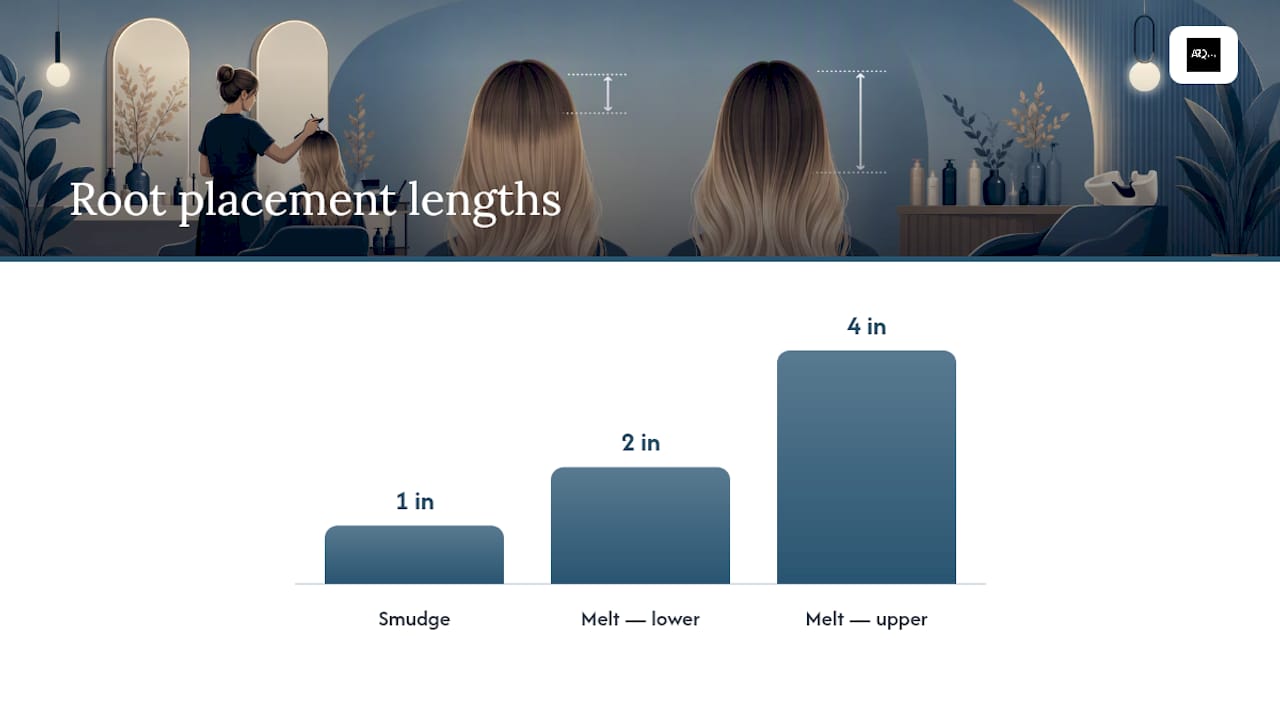
Root smudge: blend extends roughly 1 inch from the root, keeps the visual effect crisp and bright, needs a refresh every 6 to 12 weeks, and suits fine or lighter-base hair. Processing is quick, usually 10 to 20 minutes.
Root melt: blend extends 2 to 4 inches or more, produces a softer graduated gradient, lasts 8 to 16 weeks or longer depending on contrast, and suits thicker or previously lightened hair. Processing runs slightly longer to feather properly.
The trade-off in one line: a smudge buys you brightness and speed in the chair; a melt buys you time between appointments at the cost of a longer, more deliberate application. Industry guides commonly place the smudge at around one inch and the melt at two to four, which is why melts tend to win when a client’s real goal is fewer salon visits per year.
What is a root smudge in salon practice?
A root smudge is a targeted colour service that softens the demarcation line by depositing a shade close to your natural root colour, applied close to the scalp so brightness through the mid-lengths and ends stays untouched. Placement sits within the first inch or so of growth. Stylists typically formulate with a demi or semi-permanent colour rather than permanent dye, which keeps the result soft and avoids a hard band forming as it grows out.
Smudges are favoured when:
Hair is fine or fragile, where heavier permanent colour near the root risks looking flat.
The client wants crown brightness preserved rather than dimmed by a longer blend.
Regrowth is still fairly short and doesn’t need a big gradient to disguise it.
Pro Tip: Ask your stylist to check your natural root shade under daylight, not salon lighting, before mixing the smudge formula. Warm undertones shift noticeably between the two.
What is a root melt and why does it look so lived-in?
A root melt takes the same principle as a smudge and extends it, dropping depth at the base and feathering it two to four inches down the shaft so multiple tones read as one continuous gradient. The effect is dimensional rather than flat: darker at the root, gradually lighter through the mid-lengths, with no visible line where one tone stops and another begins.
Melts are often applied alongside teasylights or foil placement to build that dimension, then finished with a gloss that unifies everything into a single believable shade. Situations where a melt makes more sense:
Hair that’s been heavily lightened, where a hard root line would look jarring against pale ends.
Clients who want to stretch the gap between colour appointments as long as realistically possible.
Anyone chasing the “grown-out balayage” look rather than a crisp, freshly coloured root.
The salon process: sequence, timing and products
A clean smudge or melt depends almost entirely on sequencing. Rush the order and you get banding, not a blend.
Consultation to establish your natural base, prior colour history and the look you want to grow into.
Toning the canvas so any brassiness or uneven previous colour doesn’t throw off the new blend.
Placing dimension (foils or freehand pieces) if a melt calls for extra depth or lightness through the lengths.
Feathering the root colour downward, dragging and softening the edge so there’s no visible stop line.
Processing, typically with a demi or semi-permanent formula, which protects previously coloured hair from over-lightening while still allowing a soft blend.
Rinse and finishing gloss, the step that actually marries every tone into one cohesive colour and adds shine.
A smudge alone might take 20 to 30 minutes of processing; a full melt with placement can run considerably longer once foiling and feathering are factored in. If you’ve been lightened before, a strand test is worth insisting on before any colour goes near previously bleached hair.
Statistic Callout: Salon guides consistently cite a 1 inch placement for smudges versus 2 to 4 inches for melts, the single most useful number to remember when briefing a stylist.
Which technique suits your hair type and goals?
Matching the technique to your hair history matters more than personal preference alone.
Fine or fragile hair, natural or close-to-natural base: a smudge, since it keeps things light and avoids build-up near the scalp.
Thick hair with heavy prior lightening: a melt, which disguises a bigger gap between root and lightened lengths without a visible line.
Frequent salon visitor who wants brightness: a smudge, refreshed roughly every 6 to 12 weeks.
Busy schedule, wants maximum time between appointments: a melt, which can often stretch past 8 to 16 weeks depending on contrast.
Somewhere in between: many stylists will blend a shorter melt with smudge-level brightness near the crown, tailoring the drag length to your regrowth speed.
Don’t assume you have to pick one forever. Colour histories evolve, and a stylist can shift you from smudge to melt (or the reverse) as your hair and lifestyle change.
Maintenance, longevity and looking after the result at home
Longevity depends on how far the colour was dragged and how much contrast exists between root and ends. Smudges generally need a refresh every 6 to 12 weeks since the tighter blend shows regrowth sooner. Melts can often run 8 to 16 weeks or longer, particularly on hair with lower root-to-end contrast.
Use colour-safe shampoo and reduce wash frequency to slow fade on the toned sections.
Book a gloss refresh between full colour appointments to keep tone fresh without redoing the whole blend.
Cut back on heat styling near the root, where fresh colour is most vulnerable to fading unevenly.
At-home root touch-up sprays and powders can disguise regrowth for a photo or event, but they sit on top of hair rather than blending into it and wash out at the next shampoo. They’re a stopgap, not a substitute for the salon technique.
Your consultation checklist before booking
Bring reference photos, and be specific about lighting: a picture taken outdoors reads differently to a phone flash. A good consultation should cover:
How far down the shaft do you plan to drag the root colour?
What formula are you using, demi or semi-permanent, and why?
Will there be a finishing gloss, and is that included in the price?
If my hair has been lightened before, will you do a strand test first?
How long realistically before I need a touch-up?
Pro Tip: If a stylist promises a dramatic transformation without asking a single question about your colour history, that’s a red flag, not confidence. Walk away from anyone unwilling to test previously bleached hair before dragging fresh colour down it, and be wary of any consultation that skips discussing where the blend will actually stop.
Seeing the difference: smudge and melt side by side
Photos make this technique distinction obvious in a way description struggles to match. Line up two clients with similar natural bases: the smudge client shows a tight, soft blur confined to roughly the first inch of growth, with everything below reading bright and largely untouched. The melt client shows a longer transition, darker at the crown and gradually lightening through several inches before it meets the existing colour, with no single point where you could draw a line and say “this is where the old colour starts.”
The giveaway in both good and bad examples is the edge. A well-executed smudge has no crisp boundary between root and mid-length, just a gradual softening. A poorly done one still shows a faint ring, usually because the colourist didn’t feather the edge properly or chose a shade a shade too dark for the surrounding hair. Melts fail in a different way: instead of a smooth gradient, you get visible “steps,” patches where one tone stops abruptly and another starts, usually a sign the placement wasn’t planned before the colour went on.
What both good examples share, regardless of which technique was used, is a final gloss that ties every tone together. Skip that step and even a technically correct blend can look slightly disjointed under different lighting. If you want to judge a stylist’s skill before booking, ask to see portfolio images of root work specifically, not just finished balayage shots, since the root transition is where technique differences show up most clearly.
Advantages and disadvantages of each technique
Neither technique is objectively better; each carries trade-offs worth weighing honestly.
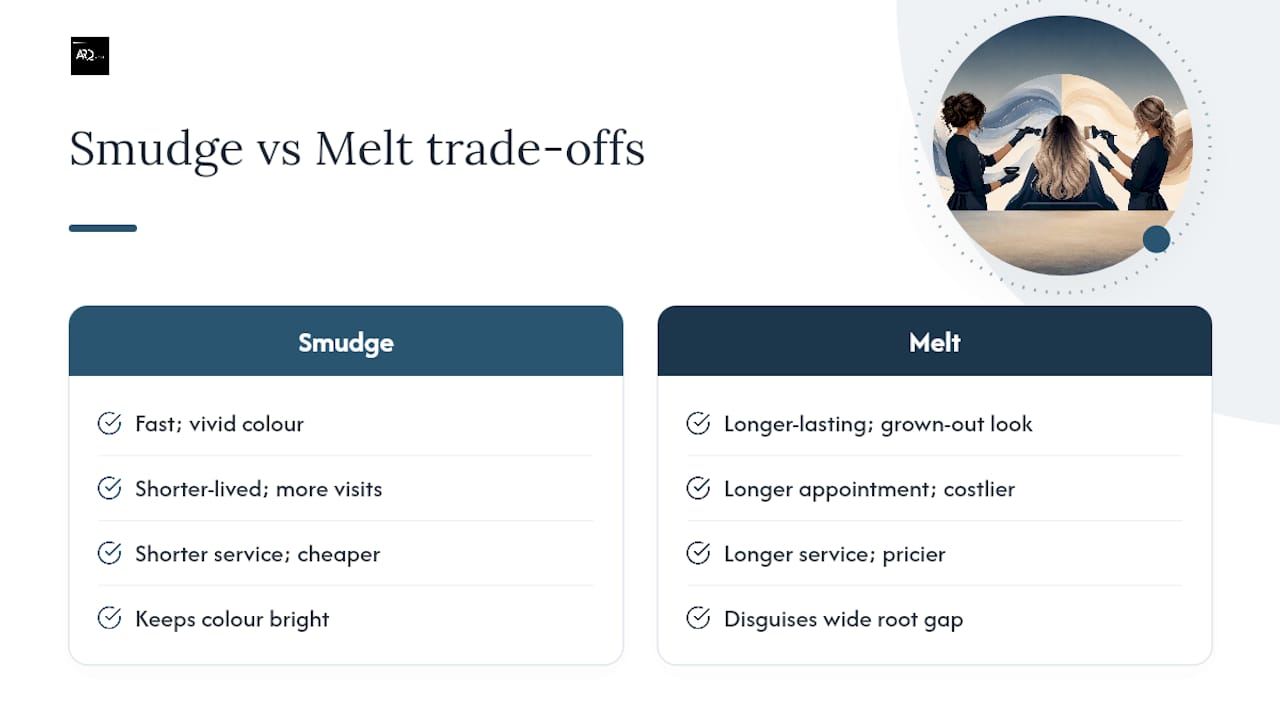
The root smudge’s biggest advantage is speed and brightness. It’s a shorter service, cheaper per visit, and keeps colour looking fresh and vivid rather than muted. Its disadvantage is frequency: because the blend is short, regrowth becomes visible sooner, meaning more trips to the salon over a year even though each one is quicker.
The root melt’s advantage is longevity and a genuinely “grown-out” aesthetic that many clients actively want rather than tolerate. It disguises a wider gap between root and lightened ends, which makes it forgiving for anyone who can’t commit to frequent appointments. The disadvantage is the appointment itself: melts typically take longer in the chair, cost more per visit because of the extra placement and blending work, and demand a more skilled colourist to avoid visible banding.
There’s also a durability nuance worth flagging: a melt done badly, with poor feathering or mismatched tones, is harder to fix quietly than a smudge gone wrong, simply because more hair is involved in the blend. A botched smudge can often be corrected with a small adjustment near the root; a botched melt sometimes needs a fuller recolour to smooth out. That’s not a reason to avoid melts, but it is a reason to prioritise stylist skill over price when booking one.
Cost comparison for root smudge vs root melt
Pricing for either technique varies by salon, region and how much additional placement (foils, teasylights) is involved, so there’s no universal figure to quote. What’s consistent across most pricing structures is the relative comparison: a root smudge is typically the cheaper single visit, since it’s a shorter, more contained service using less product and less chair time.
A root melt usually costs more per appointment because it involves more product, more placement work if foils are added, and more time to feather the blend properly. However, because melts last longer between refreshes, some clients find the annual cost comparable, or even lower, once appointment frequency is factored in. Someone getting a smudge every 8 weeks might visit the salon six or seven times a year; someone getting a melt every 12 weeks might visit four or five times.
The fairest way to compare cost isn’t the sticker price on the day, but working out for yourself, or better, with a stylist, what your realistic annual colour spend looks like under each option. Ask for a quote that separates the base service from any add-ons like extra foiling or a gloss, since bundling everything into one number makes it harder to see where the actual cost difference lies.
How to choose based on your lifestyle and hair goals
Start with how often you’re actually willing to sit in a salon chair. If quarterly visits sound reasonable and you value maximum brightness in between, a smudge fits naturally into that rhythm. If you’d rather stretch visits out and don’t mind a softer, more graduated look near the root, a melt suits your schedule better.
Next, be honest about your colour history. Heavily lightened hair generally reads better with a melt, since the longer blend disguises a bigger tonal gap without looking like an obvious patch job. Hair that’s close to its natural shade, or only lightly coloured, often doesn’t need that much blend length, a smudge does the job without unnecessary processing.
Finally, think about the look you actually want to see in the mirror day to day, not just at the moment you leave the salon. Some clients want their hair looking freshly done at all times, which favours the tighter refresh cycle of a smudge. Others actively like the “undone,” dimensional look of a longer grow-out, which is exactly what a melt is designed to deliver. Neither preference is wrong, but naming it clearly before your consultation saves time and helps your stylist formulate the right blend the first time. A brief chat about colour technique options before booking can also help narrow down which approach fits your specific hair goals.
What actually separates a good smudge or melt from a mediocre one
Most of the difference between a result that looks expensive and one that looks like a mistake comes down to sequencing, not the technique name itself. Toning the canvas first, placing any extra dimension, then feathering the root colour and finishing with a gloss, that order is what prevents the abrupt banding that makes either a smudge or a melt look unfinished.
The closing gloss is treated as non-negotiable rather than optional. Skip it, and even a technically correct blend can look slightly patchy under different light. After three decades in the business, the pattern is consistent: clients who bring a clear reference and stay open to a stylist adjusting placement to their actual regrowth pattern leave with results that hold up far better between appointments than those who ask for an exact copy of someone else’s photo.
— RICARDO
Book a bespoke root service at ARQ Hair
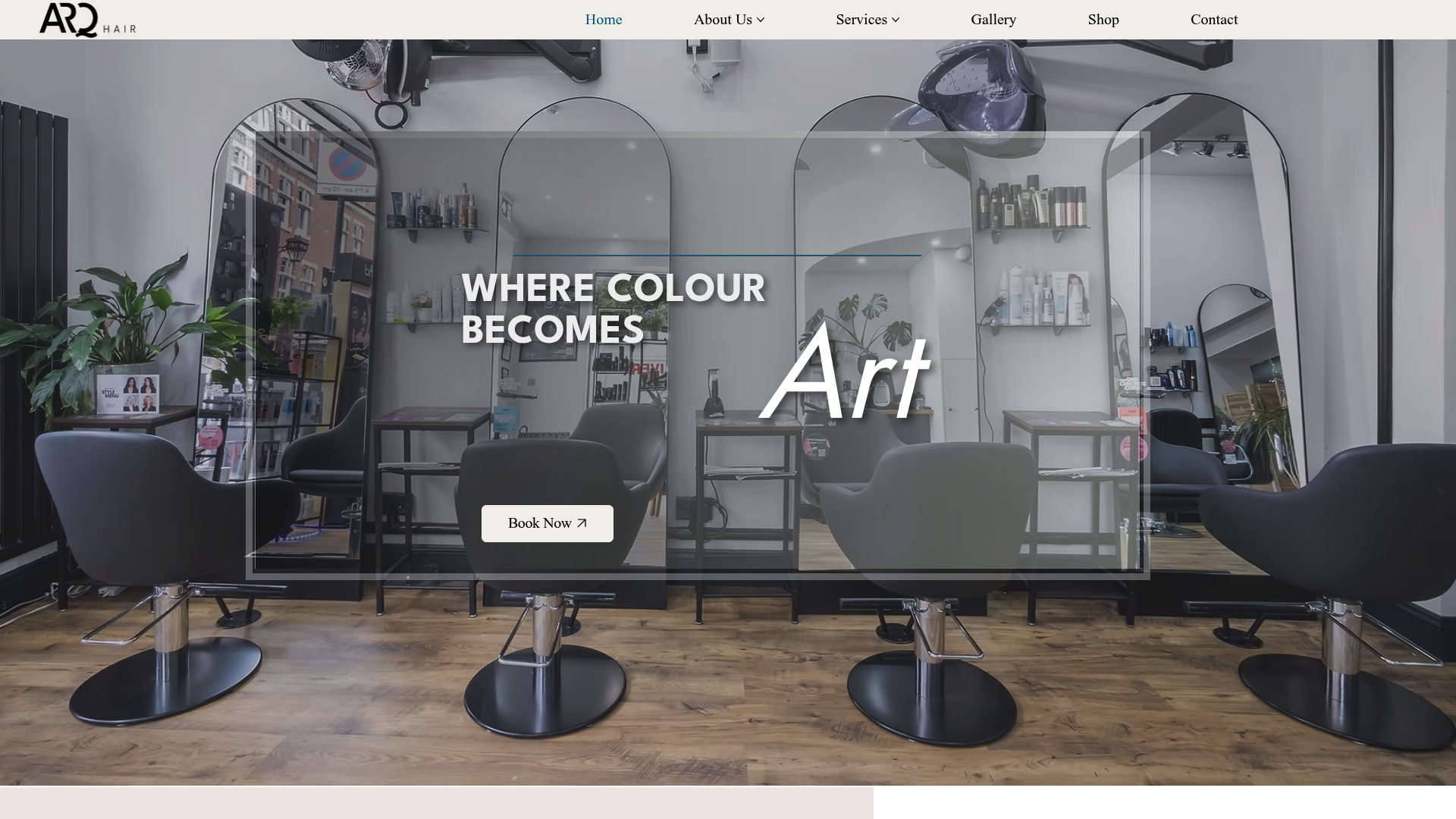
This salon offers colour appointments where colourists build every root smudge or root melt around your actual regrowth pattern and colour history, not a generic formula. That means fewer surprises between visits and a blend designed to grow out gracefully rather than needing a rescue appointment.
Whether you’re after the bright, tight blend of a smudge or the longer, dimensional fade of a melt, a proper consultation is where the right choice gets made, not a search engine. Browse bespoke colour services to see how root smudge and root melt work fit within a wider colour plan, or look at highlights and balayage if you’re considering pairing a melt with extra dimension. Book a consultation to get a formula and placement plan built around your hair, not a template.
Sources
These are useful starting points, not a substitute for a personalised in-salon consultation.
Recommended
Comments