
Gentle hair colour for sensitive scalps: safe steps and options

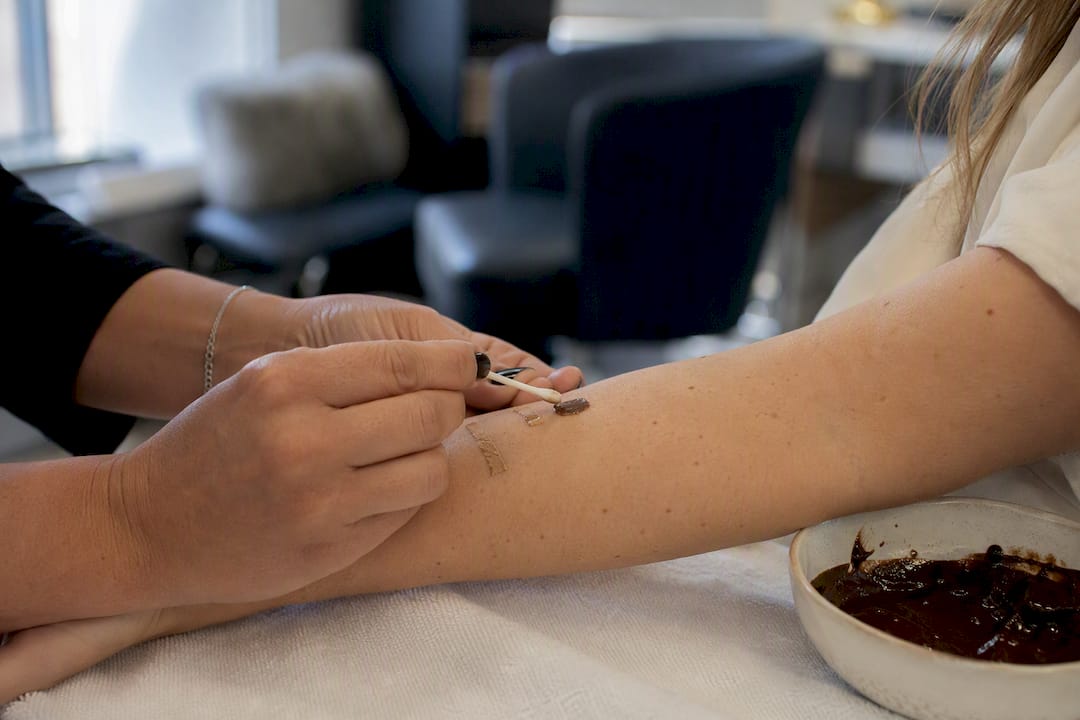
Most people with a sensitive scalp can still colour their hair safely, provided the scalp isn’t actively inflamed and a proper patch test comes back clear. That’s the honest, evidence-backed answer, and it’s the one we give clients at Arqhair every week. The exceptions matter: if your scalp is broken, weeping, sunburnt, or flaring from eczema or psoriasis right now, colour needs to wait.
Three things to do before you book anything or open a box dye:
Delay if inflamed. Active redness, broken skin, or a recent flare-up of dermatitis means the skin barrier can’t defend itself against dye chemicals. Wait until it’s settled.
Patch test 48 hours ahead. Apply a small amount of the exact product behind your ear or on your inner elbow and watch for redness, swelling, or itching over two full days, not two hours.
Book a consultation with a colourist who works with sensitive scalps regularly. They’ll ask about your history, check your scalp, and choose a technique that keeps chemicals away from irritated skin.
The NHS guidance on hair dye reactions confirms that reactions can appear immediately or take up to 48 hours to develop, which is exactly why a rushed same-day patch test tells you almost nothing. The American Academy of Dermatology also notes that persistent scalp itching after colouring deserves a proper dermatological look, not just a change of shampoo. Sensitivity doesn’t have to mean giving up colour. It means being deliberate about timing, formula, and technique.
Key Takeaways
Safe hair colouring with a sensitive scalp depends on delaying when the skin is inflamed, patch testing every product for a full 48 hours, and choosing technique and formula together rather than either in isolation.
Point | Details |
Delay when inflamed | Postpone colouring if your scalp shows redness, broken skin, or recent steroid treatment. |
Patch test for 48 hours | Test the exact product behind the ear and wait two full days, since PPD reactions can be delayed. |
Read the ingredient list | Check for PPD and ammonia specifically, and don’t assume “natural” or “herbal” products are automatically safer. |
Ask for off-scalp technique | Balayage, foiled highlights, and glossing all reduce direct scalp contact compared with full-root application. |
Choose salon support for sensitivity | Arqhair’s Wella Color Experts assess scalp history and tailor formula and placement before any colour is applied. |
Table of Contents
What causes a sensitive scalp and how it affects hair colour
A sensitive scalp isn’t one condition; for those concerned about scalp health and hair density when considering colour treatments, understanding hair loss causes can also be helpful. It’s a catch-all for several different things happening to the skin barrier, and each one changes how your scalp will cope with hair dye.
Eczema and psoriasis thin and crack the skin’s outer layer, creating microscopic openings that let chemicals penetrate faster and deeper than they would on intact skin. Contact dermatitis, often from a previous product reaction, leaves the scalp primed to flare again with even mild irritants. Sunburn does something similar on a temporary basis: the skin is already inflamed and compromised, so adding dye chemicals on top is asking for trouble. Nerve-related scalp conditions, sometimes linked to hormonal shifts or stress, can also heighten the sensation of burning or tingling during processing, even without a true allergic reaction happening underneath.
Environmental triggers pile on top of these. Hard water, over-washing, harsh shampoos, and recent chemical treatments (a perm, a relaxer, aggressive bleaching) all strip the scalp’s natural oils and weaken its barrier function. Hormonal changes, particularly around pregnancy or menopause, can also make skin that was previously untroubled suddenly react to products it once tolerated without issue.
Here’s the mechanism that matters most: your scalp’s outer layer, the stratum corneum, works like a brick wall, with skin cells as bricks and lipids as mortar. When that mortar breaks down through eczema, sunburn, over-cleansing, or age, the wall develops gaps. Hair dye chemicals, particularly small reactive molecules like PPD, exploit those gaps and reach living tissue faster, triggering the immune response that shows up as redness, swelling, or blistering.
Signs your scalp is higher risk right now
A few practical checks tell you whether today is a colouring day or a waiting day:
Visible redness or flaking anywhere on the scalp, even in a small patch.
Any broken or weeping skin, including scratches from recent itching.
Severe or persistent itching that predates the colouring appointment.
Recent dermatological treatment, such as a steroid cream or prescription retinoid, used on the scalp within the past week or two.
A known history of reaction to hair dye, black henna tattoos, or other cosmetic products.
If two or more of these apply, that’s your cue to postpone. It isn’t about being overly cautious. It’s about giving your skin the conditions it needs to actually protect you during the appointment, rather than letting dye chemicals through a barrier that’s already down.
Which ingredients cause reactions and which formulas are gentler?
Paraphenylenediamine, known as PPD, is the single most common allergen in permanent hair dye, and it’s found overwhelmingly in darker shades because it’s what creates depth and richness of colour. According to NHS guidance, a PPD reaction can appear within minutes of application or take up to 48 hours to surface, which is precisely why a same-day “quick test” at the sink tells you nothing reliable. Once someone reacts to PPD, subsequent exposures tend to provoke faster, more severe responses, so a mild reaction the first time is not something to shrug off and repeat.
Ammonia and hydrogen peroxide are a different kind of problem. Neither is typically an allergen in the immune sense; instead, they’re irritants that dry out the scalp, disrupt its pH, and can leave sensitive skin stinging, tight, or flaking for days afterwards. Lower-ammonia and ammonia-free formulas reduce this irritation without necessarily removing allergen risk entirely, which is why ingredient reading has to cover both categories separately, not just one.
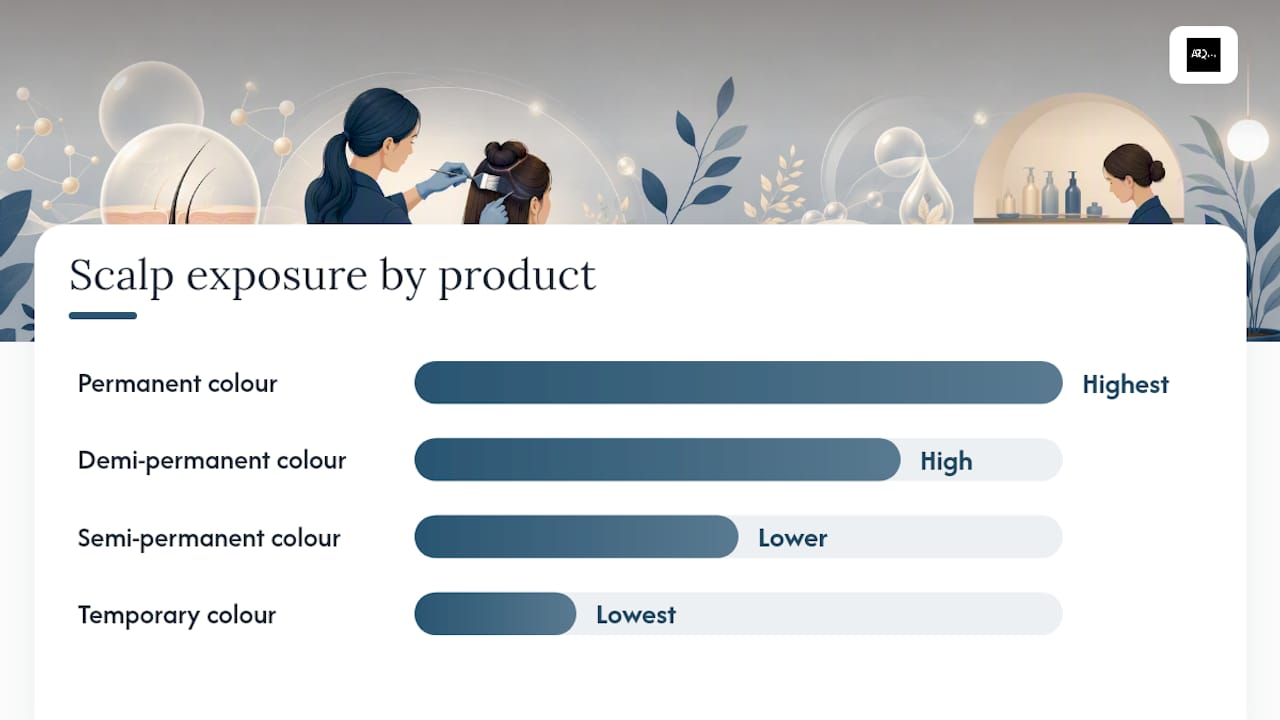
Product type changes your exposure level considerably:
Permanent colour carries the highest scalp exposure. It typically uses PPD-based dyes with ammonia and peroxide to lift and deposit colour, and it needs full scalp contact to work.
Demi-permanent colour uses lower levels of peroxide and often no ammonia, giving a gentler middle ground with less fade resistance.
Semi-permanent colour skips ammonia and peroxide almost entirely, coating the hair rather than penetrating it, though pigment choice still matters for allergen content.
Temporary colour sits on the hair surface only and washes out within a few shampoos, making it the lowest-exposure option of the four, though it offers the least longevity.
Natural alternatives sit in their own category, and this is where things get genuinely confusing for consumers. Pure henna and indigo can be a good option for people who react to synthetic dyes, since they work through plant pigment rather than PPD chemistry. But Healthline’s overview of hair dye allergy makes an important point: many products marketed as “natural” or “herbal” are adulterated with PPD to speed up colour development and improve colour payoff, particularly darker shades sold as “black henna.” Someone who thinks they’re avoiding PPD by choosing a henna-labelled product can still be exposed to it, sometimes at higher concentrations than in conventional dye. The only way to know is to check the ingredient list for paraphenylenediamine or its derivatives, not to trust the word “natural” on the packaging.
Pro Tip: Ask to see the ingredient list of any product before it touches your scalp, salon or home box alike. If PPD, PTD, or a related “diamine” compound is listed and you’ve reacted before, that’s a hard no, regardless of how the product is marketed.
How should you prepare for a colour appointment?
Preparation starts days before you sit in the chair, not the morning of.
Check your scalp condition first. If you’re dealing with active inflammation, sunburn, blistering, or you’ve used a steroid cream or prescription treatment on your scalp within the last one to two weeks, reschedule. Healing skin needs time before it can safely handle dye chemicals.
Skip the pre-appointment wash. Contrary to instinct, going in with slightly unwashed hair is better. Natural scalp oils create a thin protective layer that reduces direct chemical contact, and stripping them right before colouring leaves skin more exposed.
Avoid harsh scalp products in the run-up. Exfoliating scalp scrubs, strong medicated shampoos, or new skincare products applied near the hairline in the days before your appointment can all leave the barrier more reactive than usual.
Do a 48-hour patch test with the actual product. Apply a small amount behind the ear or on the inner elbow and leave it undisturbed. Watch for redness, swelling, or itching across the full two-day window, not just the first few hours.
Run a strand test alongside it. This checks how your hair itself responds to the formula and processing time, giving your colourist useful information about porosity and condition as well as safety.
Write down your history. Note any past reactions to hair dye, temporary tattoos (particularly black henna, which frequently contains high PPD concentrations), or other cosmetic products. Bring this with you.
Tell your colourist everything relevant, including medications, skin conditions, and recent treatments. Ask directly whether an off-scalp technique suits your situation.
Pro Tip: Keep a simple note on your phone logging every hair colour reaction you’ve ever had, however mild, along with the product and date. Sensitivity tends to build with repeated exposure, so what felt like “a bit of tingling” three years ago is exactly the detail a dermatologist or colourist needs to hear about now.
What salon techniques reduce scalp contact during colouring?
The single biggest lever a professional colourist has isn’t the product. It’s where the product actually touches your head.
Off-scalp techniques keep dye away from the root and the skin entirely. Balayage paints colour onto the mid-lengths and ends in a freehand pattern, while foiled highlights placed a few centimetres from the root avoid scalp contact almost completely. Glossing treatments, which deposit tone rather than lift colour, can often be applied with minimal root proximity too. For anyone whose sensitivity is triggered mainly by direct scalp exposure rather than the product itself, these methods can open up colour options that would otherwise feel off-limits. Arqhair’s bespoke highlights and balayage service is built around exactly this kind of controlled, root-avoiding placement.
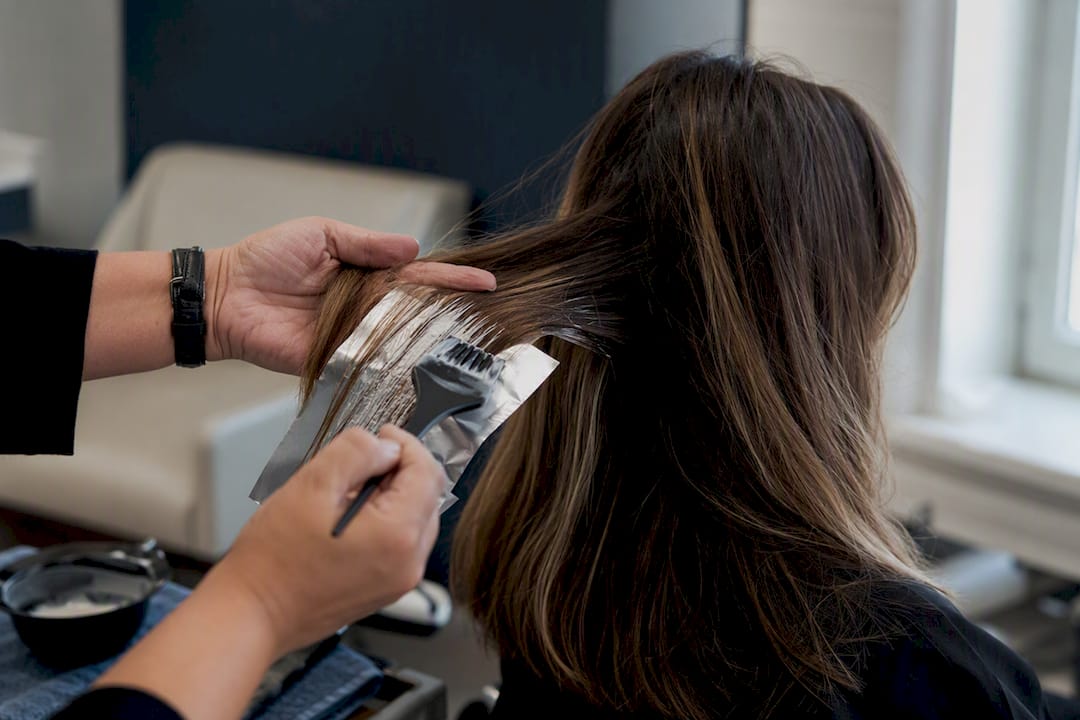
Scalp protectors and barrier creams give a second line of defence when full root coverage genuinely is the goal, such as with a regrowth tint. Colourists apply a thin layer of barrier product along the hairline and parting before colour goes on, physically limiting how much dye chemical reaches the skin during processing. It’s a small step that makes a real difference for clients who need root colour but have a known sensitivity.
Formula choice comes third, after technique and protection are settled. Skilled colourists lean toward demi-permanent, low-ammonia, or PPD-free formulas for sensitive clients wherever the desired result allows it, and Wella’s guidance on sensitive scalp colouring points specifically to lower-irritant formulas and shorter processing times as a way to protect barrier function during the service. A good consultation should cover:
What technique will keep colour away from my scalp where possible?
Which formula are you using, and does it contain PPD or ammonia?
Will you use a scalp barrier along my parting or hairline?
What’s your plan if I feel burning or stinging mid-appointment?
That last question matters more than people realise. Experienced stylists watch for early signs of irritation and will rinse a section immediately rather than letting the full processing time run, because catching a reaction at minute five is a very different situation to catching it at minute thirty. Minimising scalp time on the clock, not just choosing a “gentle” product, is often what actually prevents a bad reaction.
Can you safely colour sensitive scalp hair at home?
At-home colouring is possible for many people with sensitive scalps, but the margin for error is smaller than in a salon, so the process needs to be more careful, not less.
Semi-permanent and temporary dyes are the safer starting point for home use. They skip ammonia and peroxide, sit closer to the hair surface, and wash out over time rather than requiring another chemical process to remove. This makes them considerably lower-risk than a permanent box dye, even if the colour result is less dramatic or long-lasting.
A safer at-home routine looks like this:
Patch test the exact product 48 hours before, every single time, even with a brand you’ve used before. Formulas change, and reactions can develop with repeated exposure.
Apply away from the root where the design allows, using an applicator brush rather than saturating the whole scalp with a bottle.
Use a barrier cream or petroleum jelly along your hairline and ears before you start, the same trick colourists use in-salon.
Set a timer and don’t exceed it. Processing longer than instructed doesn’t improve colour payoff much, but it does increase scalp exposure time.
Rinse at the first sign of stinging or burning, rather than waiting to see if it passes.
At-home colouring is not the right call if you have a history of severe reactions, an active scalp condition, or you’re using a product with PPD for the first time without any patch test history at all. In those situations, the controlled environment of a salon, with a trained colourist watching for early warning signs and equipped to intervene immediately, is the safer route. Arqhair’s guide to expert hair colour techniques covers more on why professional application control matters even when the product itself is gentle.
What should you do if your scalp reacts after colouring?
Move fast, but don’t panic. Most reactions are manageable if you respond correctly in the first hour.
Rinse thoroughly with lukewarm water and a mild shampoo immediately. Don’t wait to see if discomfort passes. Getting residual product off the skin is the priority.
Stop using the product entirely, including any leave-in treatments from the same range, until you’ve identified the cause.
Apply a fragrance-free emollient to calm dry, irritated skin. For more pronounced but still mild contact dermatitis, short-term over-the-counter hydrocortisone cream can help, though it shouldn’t be used for more than a few days without medical advice.
Watch for red flags that need urgent care: swelling of the face, lips, or throat, widespread blistering, or any difficulty breathing. These require emergency medical attention immediately, not a wait-and-see approach.
See a dermatologist if symptoms persist beyond a few days or recur with future products. Patch testing under clinical supervision can pinpoint exactly which ingredient is responsible, so you’re not guessing next time.
Reaction timing tells you something useful too. An immediate sting or redness during application usually points to an irritant response. Symptoms that build over 24 to 48 hours, according to NHS guidance on hair dye reactions, are more typical of a true allergic reaction to PPD, and this delayed pattern is exactly why a same-day patch test is unreliable.
It’s worth writing down what happened while it’s fresh: which product, how long it was on your scalp, what the reaction looked like, and how quickly it appeared. A dermatology-led breakdown of scalp itch causes notes that hair dye reactions are just one of several possible causes of persistent itching, alongside dandruff, fungal infections, and psoriasis, so a clear timeline helps a dermatologist rule things in or out efficiently rather than starting from scratch.
How Arqhair approaches colour for sensitive scalps
Every colour consultation at Arqhair begins with an honest conversation about your scalp before it’s ever about the shade you want. We ask about past reactions, current skin conditions, medications, and whether you’ve had a black henna tattoo, because that history changes which formula and technique make sense for you.
Our team includes Wella Color Experts, which means the formulas we reach for and the techniques we use are informed by the same professional standards that shape Wella’s own guidance on sensitive scalp colouring, applied by colourists who’ve built a family legacy in this craft across three decades in the chair.
In practice, that means:
Off-scalp application by default for clients flagging sensitivity, using balayage or foiled placement that keeps colour away from irritated skin wherever the desired look allows.
Immediate response to discomfort mid-service. If you feel burning or stinging, we rinse straight away rather than waiting out the clock.
Lower-irritant formula choices, including demi-permanent and PPD-conscious options, discussed with you at consultation rather than assumed.
Post-colour scalp care recommendations, drawing on our scalp and hair treatment services, to help calm and support the skin barrier after processing.
If you’re navigating scalp sensitivity and unsure whether colour is even on the table for you, that’s exactly the conversation to have with us before you book, not after.
What matters most when your scalp is sensitive
The conventional advice on this topic tends to obsess over product labels: ammonia-free this, natural that. It’s not wrong, but it puts the emphasis in the wrong place. Ingredients matter, yet the research consistently points to technique and timing as the bigger levers. A skilled colourist using a “riskier” permanent formula with off-scalp placement and tight processing control will often be safer than an unsupervised at-home application of a product marketed as gentle.
The other gap in most guidance is timeline discipline. People treat the 48-hour patch test as a formality to rush through, when it’s the single most useful piece of information you can gather before colour touches your skin. Skipping it, or shortening it, defeats the entire point.
If you take one thing from this guide, prioritise history over hope. Your past reactions, however mild, predict your future ones far better than any ingredient list on its own.
— RICARDO
Book a sensitive-scalp colour consultation with Arqhair
Arqhair gives you what a box dye and a rushed high-street appointment can’t: a trained colourist who assesses your scalp before touching a single formula to it. Where generic salon visits treat every client’s scalp the same way, our consultations start with your history, your sensitivities, and a technique choice built around them rather than a fixed process everyone gets.
Our Wella Color Experts work with lower-irritant formulas, off-scalp placement, and scalp barrier techniques as standard practice for clients who flag sensitivity, not as a special request that slows things down. If you’ve been putting off colour because of a past reaction or an active skin concern, book a consultation through our colour services page and tell us about it upfront. We’ll talk through patch testing, formula options, and technique before any colour goes near your scalp, so you walk in knowing exactly what to expect and walk out with the result you actually wanted.
Sources
The safety guidance in this article draws on established medical and professional colour sources:
This article is general information, not a substitute for advice from a qualified doctor. Consult a qualified healthcare professional about your own circumstances before acting on anything here.
Recommended
Comments