
Gentle Colour Options for Ammonia Sensitivity at the Salon

Quick Summary
Yes, gentle colour options for ammonia sensitivity are available at the salon. Ammonia-free formulas usually replace ammonia with monoethanolamine (MEA), which gives far less vapour and odour, while a patch test shows whether your skin reacts to the colour mixture.
Ammonia-free colour swaps ammonia for monoethanolamine (MEA), which has a milder odour.
Ammonia-free does not mean free of PPD, which can cause allergic contact dermatitis.
A patch test should be done at least 48 hours before the full colour service.
A patch test checks skin reactions; a strand test only shows how the colour performs on hair.
Book a consultation first if you have had a previous reaction to hair dye.
Gentle colour that suits sensitive skin?
ARQ Hair in Fulham offers Wella Colour expertise with a gentler approach for clients with ammonia sensitivity.
Table of Contents
Last Updated: November 19, 2026
For many clients, a colour appointment is not just about the result. It is about whether the chemistry on their scalp will leave them itching, burning or worse for the next week. If you have ammonia sensitivity, you do not have to give up professional colour to protect your skin. Gentle colour options for ammonia sensitivity are available at the salon, and the right choice depends on understanding what the label actually means. This guide explains the options, the trade-offs and how to book a consultation that gets you a safe, lasting result.
What Ammonia-Free Hair Colour Actually Means
Ammonia-free hair colour is a permanent or demi-permanent formula that replaces ammonia with a different alkalising agent, most commonly monoethanolamine (MEA). Ammonia's job is to swell the hair cuticle and create an alkaline environment so the colour precursors can penetrate and oxidise inside the cortex. MEA does the same job at a similar pH but with a milder odour and, for many clients, less immediate sting at the point of application. That is the whole of the claim: one alkalising agent swapped for another.
"Ammonia-free" tells you about a single ingredient. It does not tell you the formula is free of the ingredients most often linked to reactions. To assess a colour properly, read the ingredient list or ask your colourist to check it, and compare the components that actually matter:
Ammonia, the traditional alkaliser. It lifts the cuticle efficiently and gives fast, high-lift development, but the vapour is what causes the familiar sharp smell and the stinging sensation many clients associate with colour.
MEA (monoethanolamine), the usual ammonia substitute. It is less volatile, so there is far less vapour and odour, but it is still an alkaline agent and can irritate a reactive scalp. It is not automatically gentler for every client; it is gentler in a different way.
PPD (paraphenylenediamine), the primary dye precursor in most permanent and many demi-permanent colours, ammonia-free or not. PPD is a well-recognised cause of allergic contact dermatitis, and an ammonia-free formula can contain exactly the same PPD load as a conventional one.
PTD (paratoluenediamine), a related precursor sometimes used as a PPD alternative. It may suit some clients who react to PPD, but cross-reactivity is possible, so it is not a guaranteed swap.
Fragrance and preservatives, often overlooked. A fragrance mix or a preservative can trigger irritation even when the colour chemistry itself is tolerated.
A common pattern in salon consultations is that a client who reacts to conventional colour is reacting to PPD or to fragrance rather than to ammonia itself. That distinction changes which formula is safe, which is why the ingredient list matters more than the front-of-pack claim. If you want the background on how reactions are identified, the NHS guidance on hair dye allergy and patch testing is a useful reference: NHS guidance on hair dye allergy and patch testing.
Ammonia versus ammonia-free colour
Ammonia-based colour usually develops faster and can lift more pigment in a single session, which is why it remains common for high-lift blondes and resistant grey. Ammonia-free formulas tend to work more gently, with a softer smell and less immediate sting, but they may be less effective at lifting very dark hair and often need a longer development time. Neither type is automatically safer for everyone: the question is which ingredient is causing your problem, not which word is on the box.
Benefits and limitations of ammonia-free formulas
The main benefit is comfort. Clients with a reactive scalp often find ammonia-free colour more tolerable during and after application, and the reduced odour makes the appointment more pleasant. The limitations are real: coverage of stubborn greys can be less predictable, colour may fade faster on some hair types, and lifting very dark hair in one visit is harder. Your colourist should discuss this before mixing anything, so you know what to expect from the result.
Ammonia Sensitivity Versus Allergy to Other Colour Ingredients
Many clients use "allergy" and "sensitivity" interchangeably, but they are different. Sensitivity usually means irritation: stinging, redness or a tight, uncomfortable scalp. An allergy is an immune response, and it can become more severe with each exposure. A patch test is the only reliable way to tell which one you are dealing with and which ingredient is responsible.
If you have had a reaction before, tell the salon exactly what happened, what product you used and when it occurred. That history shapes which formula is safe to use. Do not assume an ammonia-free product is risk-free because it sounds gentler.
Hair Colour for Sensitive Scalp: Who Should Be Careful and Why
Some clients need extra care before any colour service. This includes anyone with a history of dermatitis or eczema on the scalp, recent scalp injury, broken or irritated skin, or a previous reaction to hair dye. Pregnant clients and those with reactive skin conditions should also raise this with their stylist before booking.
A sensitive scalp is not a reason to avoid colour altogether. It is a reason to plan. Your stylist can choose a lower-risk formula, apply colour away from the scalp where possible and shorten contact time. For more on managing colour around sensitive skin, see our guide to hair colour for sensitive scalp.
Hair Dye Allergy Patch Test and Strand Test: What to Expect at the Salon
A patch test and a strand test answer two different questions, and a well-run salon will treat them as separate steps rather than one combined box-tick.

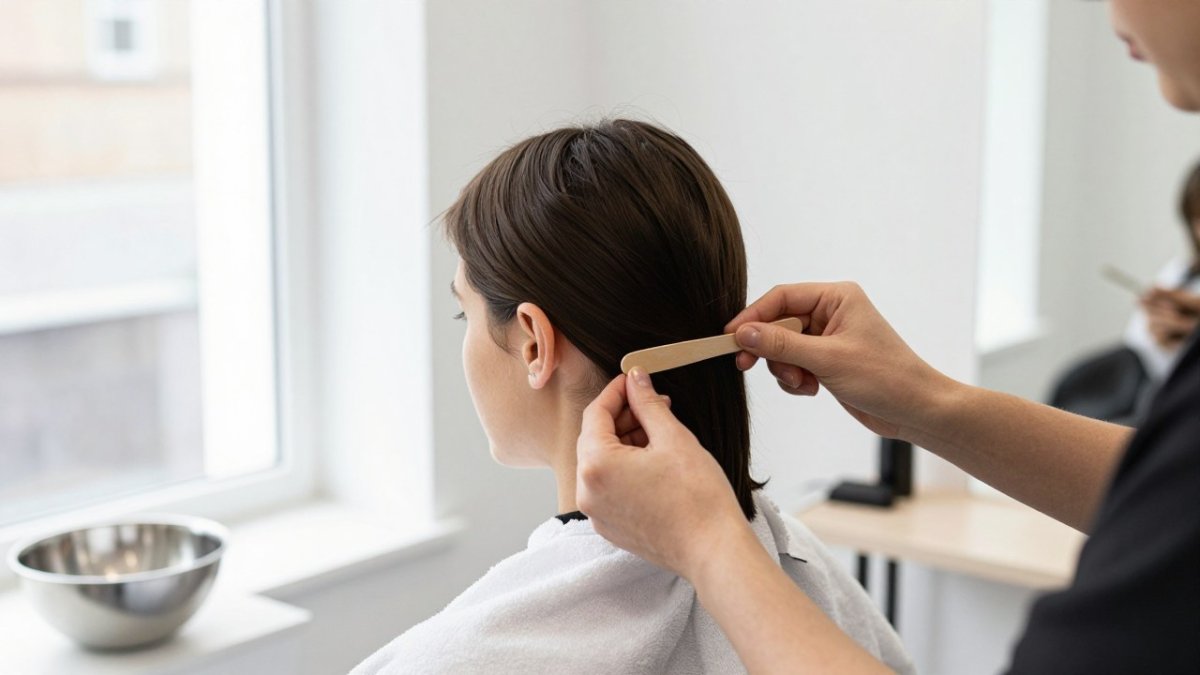
A patch test checks whether your skin reacts to the colour mixture. A small amount is applied to a patch of skin, usually behind the ear or inside the elbow, and left for the period the manufacturer specifies, typically 48 hours before the full service. A reaction can take up to 48 hours to appear, which is why a patch test is usually done ahead of colouring (the NHS). A patch test is only valid for the product actually tested, so if your colourist changes formula or brand, ask whether a fresh test is needed.
A strand test checks how the colour performs on your hair: the resulting shade, the lift achieved and the condition afterwards. It tells you nothing about whether your skin will react. Your colourist may do both, but a strand test never replaces a patch test.
In practice, a typical booking sequence looks like this:
Consultation first. Book a consultation rather than a full colour appointment if you have a history of reactions. Bring a list of products you have reacted to, what the reaction looked like and how soon it appeared.
Patch test at least 48 hours before. Do not wash the patch area or apply other products to it during the wait.
Strand test where the result is uncertain. If you are moving from dark to light or covering resistant grey, a strand test on a small section shows what the formula can achieve before the full service.
Full service only after a clear result. If the patch area shows any redness, itching or swelling, the service should be postponed and the formula reviewed, not simply swapped on the day.
Watch out: a "sensitivity" that appears within minutes of application is not the same as a delayed allergy that appears 24 to 48 hours later, and only the delayed patch test will catch the latter. If you have ever had swelling, blistering or a reaction that spread beyond the scalp, say so at consultation, that history may mean colour should be avoided altogether rather than reformulated.
If you are unsure whether you need a patch test, our guide on whether a patch test is essential for semi-permanent dye explains when it matters most.
The steps below set out the usual booking sequence, with the timing for each stage.
Step | What to do | Timing |
Consultation | Bring a list of products you have reacted to | Before booking |
Patch test | Apply a small amount to a patch of skin | At least 48 hours before |
Strand test | Test colour on a small section of hair | Where the result is uncertain |
Full service | Proceed only after a clear patch result | After a clear result |
Ammonia-Free Professional Hair Colour Options by Goal
The right formula depends on what you want to achieve. A client covering grey hair needs a different product from one who wants a subtle refresh or a bold change.
For full grey coverage, a demi-permanent or permanent ammonia-free formula is usually the most reliable choice. For a softer, lower-commitment shift, a gloss or semi-permanent colour may be enough. If your hair is fragile, our guide to the best hair dye for brittle hair covers low-damage options. For darker hair that needs a gentle refresh, a colour depositing conditioner for dark hair can work well between salon visits.
At ARQ Hair, we use Wella Colour formulas. Pricing depends on hair length, colour required and the services involved, so please check our website or ask for a quote before booking.
Hair Highlights for Sensitive Scalp: Techniques That Limit Contact
Highlights are often the most comfortable option for clients with a reactive scalp, because the product stays away from the skin. Foil highlighting, balayage and babylights all place colour on sections of hair rather than across the whole head.
You can ask your stylist to keep product off the scalp, and to rinse thoroughly at the end of the service.
Booking Your Gentle Colour Consultation at ARQ Hair
A consultation is the best way to decide which option suits your skin and your hair. Discuss your history of reactions, your hair condition and what you want the colour to do.
Book a gentle colour consultation to talk through your options before your appointment. Bring a list of any products you have reacted to, and tell us about any changes to your scalp.
Frequently Asked Questions
What professional hair colour options are available if I am sensitive to ammonia?
Several professional options are formulated without ammonia, including ammonia-free permanent and demi-permanent colours. Ammonia-free formulas typically use alternative alkalising agents, which can feel gentler on a sensitive scalp. Results can differ from traditional colour, particularly for full grey coverage and long-lasting vibrancy, so ask your colourist which formula suits your goal. At ARQ Hair, colour is customised to your hair and desired result, and pricing depends on the service and your hair length and condition, so contact the salon for a quote.
Is ammonia-free hair dye safer for a sensitive scalp?
Ammonia-free hair dye can be a better choice if ammonia is the specific trigger for your irritation, because it removes one common irritant. However, ammonia-free does not mean allergen-free. Other ingredients, including some oxidative dye precursors, can still cause reactions in sensitive people. A patch test and a consultation are the safest way to find out what your scalp tolerates before a full colour service.
Can ammonia-free hair colour still cause an allergic reaction?
Yes. Allergic reactions are usually triggered by a specific ingredient rather than ammonia alone, most commonly paraphenylenediamine (PPD) or related compounds found in many permanent dyes. Ammonia-free products may still contain these. If you have previously reacted to hair dye, tell your colourist before the appointment, bring details of past products if you have them, and ask for a patch test at least 48 hours before colouring.
Should I have a patch test before using professional hair colour?
A patch test is strongly recommended if you have a sensitive scalp, a history of reactions, or are trying a new formula. A small amount of colour is applied behind the ear or on the inner elbow and checked after 48 hours for redness, itching or swelling. Patch tests do not guarantee the absence of reaction, but they help identify ingredients you should avoid. If you react, stop immediately and seek medical advice.
Comments